Report an issue
Tell us what's wrong and we'll take a look.
Thanks – we got it. We'll review and follow up if needed.
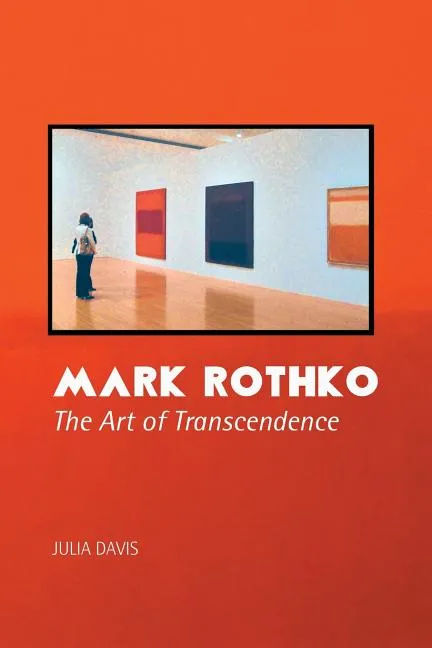
MARK ROTHKO
THE ART OF TRANSCENDENCE
By Julia Davis
Mark Rothko (1903-1970, born Marcus Rothkowitz in Dvinsk, Russia) is one of the great 20th century American artists. A huge amount of material that has grown up around Rothko. Like Vincent van Gogh, Pablo Picasso, Claude Monet and Leonardo da Vinci, Mark Rothko has been lionized by hundreds of art critics. Rothko remains a greatly admired painter. His works will not, it seems, reach the same mass audiences as Monet or van Gogh, perhaps because Rothko is an abstract artist, and very few abstract artists achieve the mega stature of figurative painters such as van Gogh or Monet.
Abstract art of the Mark Rothko kind - the colorfield skeins of Morris Louis, or the black stripes of polychrome shaped canvases of Frank Stella, or the bold, black, calligraphic brushstrokes of Franz Kline - has yet to become as widely accepted as Gustav Klimt's nudes or Sandro Botticelli's Madonnas. In the art world itself, though, Mark Rothko is a highly celebrated painter. He appears in the 20th century Olympian pantheon alongside Jackson Pollock, Piet Mondrian, Paul Klee, Robert Rauschenberg and Jasper Johns.
Mark Rothko's art has been seen by critics as 'transcendent' (Ashton, Robertson), 'a sort of spiritual Stonehenge' (Brookner), 'lavish self-indulgence' (Kozloff), 'Dionysian' (Hobbs), 'sensuous and and spiritual' (Waldman), 'enormous, beautiful, opaque surfaces' (Selz), 'enigmatic, gripping presence' (Goldwater), 'incandescent color' (Greenberg), 'haunting' (Sylvester), 'visionary simplicity' (Sandler) and 'tinted hallucinatory cloth' (de Kooning). For poet John Ashbery, Rothko 'seems to eliminate criticism'.
The archetypal response to Mark Rothko's art is that it is a (1) 'heroic', (2) 'transcendent', (3) 'spiritual' and (4) 'tragic' art. These are four of the most commonly deployed adjectives in Rothko art criticism (others include 'Buddhist', 'Faustian' and 'death-conscious'). Rothko's painting is seen as (1) 'heroic' because it attempts achieve something great in a world of Existential suffering. Out the slime and the pain and the horror of modern life rise Rothko's 'heroic' canvases. His canvases become a gesture of affirmation in amongst the global angst (as with Rothko's contemporaries, such as Pollock and Newman).
REVISED AND UPDATED, WITH NEW ILLUSTRATIONS
Fully illustrated, with a revised text. Bibliography and notes. Also available in hardback.
www.crmoon.com



Why Readwise Books?
Readwise Books is an ebook & audiobook platform that automatically logs how much you and your friends read, making it fun and easy to read more. Learn more →