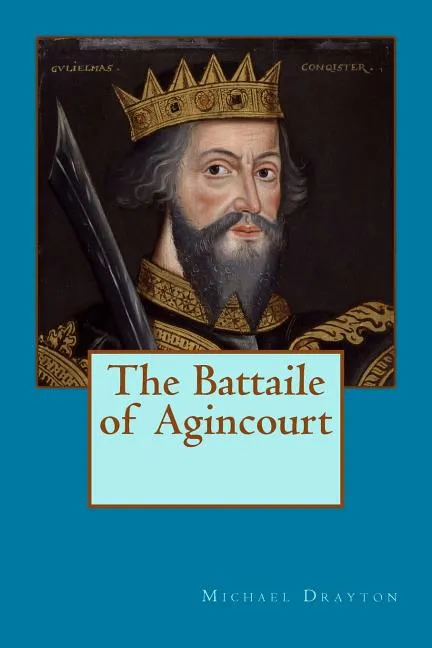
The Battaile of Agincourt
Report an issue
Tell us what's wrong and we'll take a look.
Thanks – we got it. We'll review and follow up if needed.
To you those Noblest of Gentlemen, of these Renowned Kingdomes of Great Britaine: who in these declining times, haue yet in your braue bosomes the sparkes of that sprightly fire, of your couragious Ancestors; and to this houre retaine the seedes of their magnanimitie and Greatnesse, who out of the vertue of your mindes, loue and cherish neglected Poesie, the delight of Blessed soules, and the language of Angels. To you are these my Poems dedicated, By your truly affectioned Seruant, MICHAELL DRAYTON. The Battle of Agincourt (was a major English victory in the Hundred Years' War. The battle took place on 25 October 1415 (Saint Crispin's Day) in the County of Saint-Pol, Artois, some 40 km south of Calais (now Azincourt in northern France).[6][b] Along with the battles of Crécy (1346) and Poitiers (1356), it was one of the most important English triumphs in the conflict. England's victory at Agincourt against a numerically superior French army crippled France, and started a new period in the war during which the English began enjoying massive military successes. After several decades of relative peace, the English had renewed their war effort in 1415 amid the failure of negotiations with the French. In the ensuing campaign, many soldiers perished due to disease and the English numbers dwindled, but as they tried to withdraw to English-held Calais they found their path blocked by a considerably larger French army. Despite the disadvantage, the following battle ended in an overwhelming tactical victory for the English. King Henry V of England led his troops into battle and participated in hand-to-hand fighting. The French king of the time, Charles VI, did not command the French army himself, as he suffered from severe psychotic illnesses with moderate mental incapacitation. Instead, the French were commanded by Constable Charles d'Albret and various prominent French noblemen of the Armagnac party. This battle is notable for the use of the English longbow in very large numbers, with the English and Welsh archers forming up to 80 percent of Henry's army. The decimation of the French cavalry at their hands is regarded as an indicator of the decline of cavalry and the beginning of the dominance of ranged weapons on the battlefield. Agincourt is one of England's most celebrated victories. The battle is the centrepiece of the play Henry V by Shakespeare.
Michael Drayton
Michael Drayton (1563-1631), probably the bestselling English poet of his era, wrote prolifically in many different genres. He is remembered particularly for his love sonnets ("Since there's no help, come, let us kiss and part...") and historical poems ("Fair stood the wind for France..."). "One of the most lovable of our elder poets" (in A. H. Bullen's much-quoted description), he was buried in Westminster Abbey.
More by Michael Drayton




Why Readwise Books?
Readwise Books is an ebook & audiobook platform that automatically logs how much you and your friends read, making it fun and easy to read more. Learn more →