Report an issue
Tell us what's wrong and we'll take a look.
Thanks – we got it. We'll review and follow up if needed.
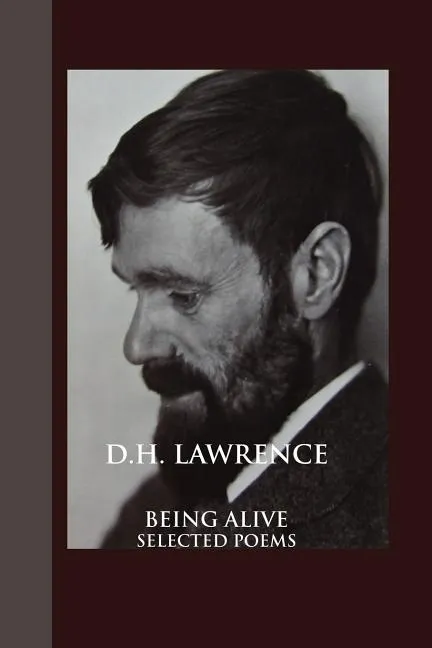
D.H. Lawrence: Being Alive: Selected Poems
Edited with an introduction by Margaret Elvy
D.H. Lawrence's strident and idiosyncratic evocations of sex, touch, Spring, flowers, nature, love, black suns, fish and other glories are gathered here in this new selection.
British Poets Series. Bibliography and notes.
D.H. Lawrence's poetry is far less known than his fiction. It is often loose, rather than fluid, and unstructured rather than 'free' verse, and messy rather than well-defined. It is a poetry, as Lawrence stresses, of the moment, a poetry in the process of becoming, constantly dissolving.
In the Foreword to his book Pansies, he wrote of that breathless transience, embodied for him in the life of a flower: the breath of the moment, and one eternal moment easily contradicting the next eternal moment. Only don't nail the pansy down. You won't keep it any better if you do.'
In the introduction to the American edition of New Poems, Lawrence wrote:
Let me feel the mud and the heavens in my lotus. Let me feel the heavy, silting, sucking mud, the spinning of sky winds. Let me feel them both in purest contact, the nakedness of sucking weight, nakedly passing radiance. Give me nothing fixed, set, static. Don't give me the infinite or the eternal: nothing of infinity, nothing of eternity. Give me the still, white seething, the incandescence and the coldness of the incarnate moment: the moment, the quick of all change and haste and opposition: the moment, the immediate present, the Now. The immediate moment is not a drop of water running downstream. It is the source and issue, the bubbling up of the stream. Here, in this instant moment, up bubbles the stream of time, out of the wells of futurity, flowing on to the oceans of the past. The source, the issue, the creative quick. There is poetry of this immediate present, instant poetry, as well as poetry of the infinite past and the infinite future. The seething poetry of the incarnate Now is supreme, beyond even the everlasting of the before and after.
Lawrence's typical poetry occurs in poems such as 'Sicilian Cyclamens', 'Snake' and 'Snap-Dragon', longish, loose poems with a lot space that allow Lawrence to explore his subject.
Lawrence covers a surprisingly wide range of subjects in his poesie - far wider than, say, Robert Graves or Thomas Hardy or John Keats. Among poets, there is no one quite like him. Like every poet, he has his pet notions, and keeps hacking away at them: the river of blood of the Sons and Lovers era, the 'democracy of touch' from Lady Chatterley's Lover, the Christological machismo of The Plumed Serpent lyrics, the hatred of labour, the love of all things Mediterranean, and the primacy of the body.
D H Lawrence
David Herbert Lawrence was born on 11th September 1881 in Eastwood, a small mining village in Nottinghamshire, in the English Midlands. Despite ill health as a child and a comparatively disadvantageous position in society, he became a teacher in 1908, and took up a post in a school in Croydon, south of London. His first novel, The White Peacock, was published in 1911, and from then until his death he wrote feverishly, producing poetry, essays, plays, travel books, short stories, and eleven more novels, including The Rainbow, Women in Love and Lady Chatterley’s Lover. Lawrence travelled widely, settling for periods in Italy, New Mexico and Mexico. He married Frieda Weekley in 1914 and died of tuberculosis in 1930.
More by D H Lawrence






Why Readwise Books?
Readwise Books is an ebook & audiobook platform that automatically logs how much you and your friends read, making it fun and easy to read more. Learn more →