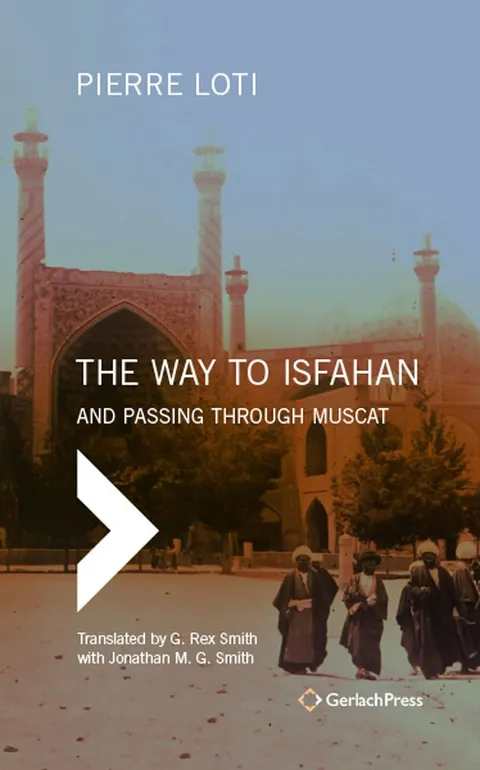
The Way to Isfahan
And Passing through Muscat - An Account of a Trip to Persia and Oman in 1900
Report an issue
Tell us what's wrong and we'll take a look.
Thanks – we got it. We'll review and follow up if needed.
From 17 April, 1900, to 6 June of that year, Pierre Loti travelled in a private capacity from Bushire on the Persian Gulf, northwards through Shiraz, Persepolis, Isfahan and Tehran, before returning via the Caspian Sea to Europe. This is the personal day-by-day account of his journey, the hardships of the mountainous terrain and the empty desert. Loti excels in his descriptions of the world around him: the sky, the mountains, the fertile plains, the deserted desert. His descriptions of the people he meets, their dress and manners are remarkable. Loti had come from India and on his way to the Gulf, he stopped off at Muscat and his account of this brief visit was published as 'En passant a Mascate' (Passing through Muscat). This is the first English translation of both texts.
Pierre Loti
Pierre Loti was a French naval commander and novelist renowned for his exotic novels and short stories. Loti was born into a Protestant family in Rochefort, Charente-Maritime, and received his early schooling there. At the age of 17, he enrolled in Brest's naval school and attended Le Borda. He progressively advanced in his career, reaching the rank of captain in 1906. In January 1910, he was placed on the reserve list. He used to claim that he never read books, telling the Académie française on the day of his introduction (7 April 1892), "Loti ne sait pas lire" ("Loti doesn't know how to read"), but testimony from friends and his library, much of which is preserved in his house in Rochefort, show otherwise. In 1876, fellow naval officers convinced him to write new chapters in his diary about some strange encounters in Istanbul. The result was the anonymously published Aziyadé (1879), which was half romance and part autobiography, similar to the work of his admirer, Marcel Proust, who followed him. Loti traveled to the South Seas as part of his naval training, spending two months in Papeete, Tahiti in 1872, where he "went native". Several years later, he published the Polynesian idyll Rarahu (1880), which was eventually reprinted as Le Mariage de Loti, the first work that introduced him to the general public.
More by Pierre Loti














Why Readwise Books?
Readwise Books is an ebook & audiobook platform that automatically logs how much you and your friends read, making it fun and easy to read more. Learn more →