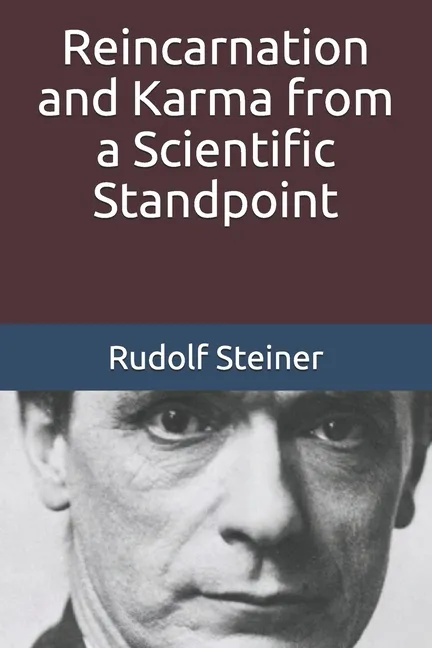
Reincarnation and Karma from a Scientific Standpoint
Report an issue
Tell us what's wrong and we'll take a look.
Thanks – we got it. We'll review and follow up if needed.
This present lecture was originally published in Steiner's periodical Lucifer-Gnosis in the October/November issue of 1903. It is truly exceptional in Steiner's work, and it is a pity that it is buried in an untranslated volume of the Collected Works. It is exceptional in at least three ways. First, it is a closely argued engagement with the contemporary science of his day. Somewhat surprisingly, given later statements, he is a proponent of Darwinism here, more specifically, the variant promoted by the German champion of Darwinism, Ernst Haeckel. Secondly, Steiner makes a limited number of points, but establishes those arguments very fully. And finally, he argues very strongly that it is the task of European and American civilization to reconcile Eastern wisdom with Western science. Steiner's first point is one he makes elsewhere, but nowhere as strongly as here. Francesco Redi was a hero because he opposed spontaneous generation, arguing that life arises only from life. He was nearly burned at the stake by the Inquisition for this heretical view, but subsequent scientific developments have shown he was absolutely right. Anthroposophists are in a similar situation today, because they argue that soul can only arise out of soul. They are mocked for it now, but future science will prove that this is correct. Steiner second point is about a fundamental distinction between humans and animals. Humans have individual biographies, but animals have group-souls. Lions are all similar in ways that humans are not. And Steiner's third point is the most important, and the most elegant. Haeckel had argued that there is a greater difference between the highest animal and the lowest human than between the lowest human and the highest. Surprisingly, Steiner assents vigorously to this proposition, and he argues beautifully that it follows that the same evolution from the highest animal to the lowest human must also be assumed between the lowest human and the highest. But because humans have individual biographies, it follows further that the only possible antecedent of a higher human form is the same soul in an earlier incarnation. Enjoy this little gem of an argument.
Rudolf Steiner
Rudolf Steiner (1861-1925) was born in the small village of Kraljevec, Austro-Hungarian Empire (now in Croatia), where he grew up. As a young man, he lived in Weimar and Berlin, where he became a well-published scientific, literary, and philosophical scholar, known especially for his work with Goethe's scientific writings. At the beginning of the twentieth century, he began to develop his early philosophical principles into an approach to systematic research into psychological and spiritual phenomena. Formally beginning his spiritual teaching career under the auspices of the Theosophical Society, Steiner came to use the term Anthroposophy (and spiritual science) for his philosophy, spiritual research, and findings. The influence of Steiner's multifaceted genius has led to innovative and holistic approaches in medicine, various therapies, philosophy, religious renewal, Waldorf education, education for special needs, threefold economics, biodynamic agriculture, Goethean science, architecture, and the arts of drama, speech, and eurythmy. In 1924, Rudolf Steiner founded the General Anthroposophical Society, which today has branches throughout the world. He died in Dornach, Switzerland.
More by Rudolf Steiner




Why Readwise Books?
Readwise Books is an ebook & audiobook platform that automatically logs how much you and your friends read, making it fun and easy to read more. Learn more →