Report an issue
Tell us what's wrong and we'll take a look.
Thanks – we got it. We'll review and follow up if needed.
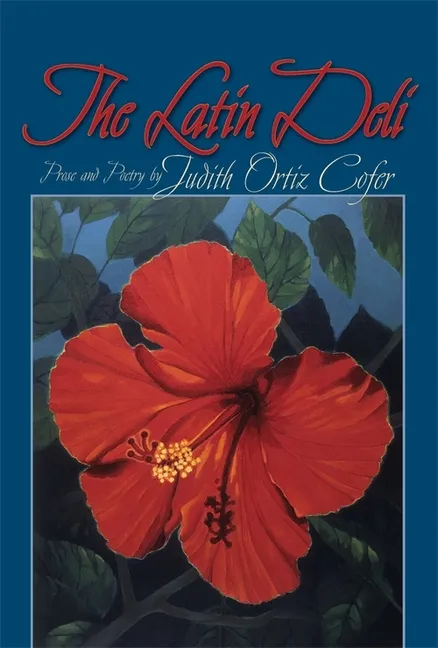
Reviewing her novel, The Line of the Sun, the New York Times Book Review hailed Judith Ortiz Cofer as "a writer of authentic gifts, with a genuine and important story to tell." Those gifts are on abundant display in The Latin Deli, an evocative collection of poetry, personal essays, and short fiction in which the dominant subject—the lives of Puerto Ricans in a New Jersey barrio—is drawn from the author's own childhood. Following the directive of Emily Dickinson to "tell all the Truth but tell it slant," Cofer approaches her material from a variety of angles.
An acute yearning for a distant homeland is the poignant theme of the title poem, which opens the collection. Cofer's lines introduce us "to a woman of no-age" presiding over a small store whose wares—Bustelo coffee, jamon y queso, "green plantains hanging in stalks like votive offerings"—must satisfy, however imperfectly, the needs and hungers of those who have left the islands for the urban Northeast. Similarly affecting is the short story "Nada," in which a mother's grief over a son killed in Vietnam gradually consumes her. Refusing the medals and flag proferred by the government ("Tell the Mr. President of the United States what I say: No, gracias."), as well as the consolations of her neighbors in El Building, the woman begins to give away all her possessions The narrator, upon hearing the woman say "nada," reflects, "I tell you, that word is like a drain that sucks everything down."
As rooted as they are in a particular immigrant experience, Cofer's writings are also rich in universal themes, especially those involving the pains, confusions, and wonders of growing up. While set in the barrio, the essays "American History," "Not for Sale," and "The Paterson Public Library" deal with concerns that could be those of any sensitive young woman coming of age in America: romantic attachments, relations with parents and peers, the search for knowledge. And in poems such as "The Life of an Echo" and "The Purpose of Nuns," Cofer offers eloquent ruminations on the mystery of desire and the conflict between the flesh and the spirit.
Cofer's ambitions as a writer are perhaps stated most explicitly in the essay "The Myth of the Latin Woman: I Just Met a Girl Named Maria." Recalling one of her early poems, she notes how its message is still her mission: to transcend the limitations of language, to connect "through the human-to-human channel of art."
Judith Ortiz Cofer
Judith Ortiz Cofer was a critically acclaimed and widely published poet, novelist, and essayist who knew that "words have the power to transform you and give you the power to shape your life. The minute you open your mouth, you have introduced yourself." She wrote extensively about the experience of being Puerto Rican and her identity as a woman and writer in the U.S. She was the lauded Regents and Franklin Professor of Creative Writing at the University of Georgia where she taught literature and creative writing. Learn more about her life and works at http: //judithortizcofer.english.uga.edu.
More by Judith Ortiz Cofer




Why Readwise Books?
Readwise Books is an ebook & audiobook platform that automatically logs how much you and your friends read, making it fun and easy to read more. Learn more →