Report an issue
Tell us what's wrong and we'll take a look.
Thanks – we got it. We'll review and follow up if needed.
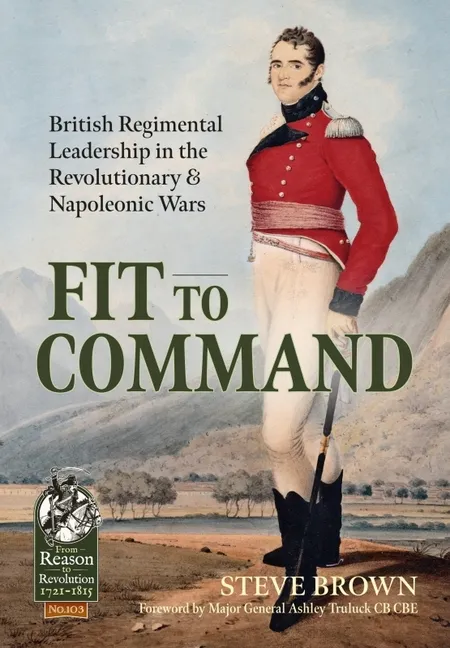
First in-depth study of what a Commanding Officer in the British army did during the Revolutionary and Napoleonic era.
Regimental and battalion commanders are perhaps the most-overlooked cohort of the British Army during the period of the Revolutionary and Napoleonic Wars. Nineteenth-century histories tending to be written from the top-down, such that the decisions of the commanding generals took primacy; the battalion commanders existed at the very bottom of that chain and so were infrequently seen. In contrast, contemporary works have concentrated on a bottom-up view of history, placing the memoirs of the rank & file and junior officers as central to the action, and for these writers the battalion commanders generally existed at the rarely-seen outer edge of their regimental experience.
We are left with a documentary vacuum at field officer levels. Yet within this vacuum, battalion commanders - lieutenant-colonels and majors - were undertaking a very difficult task for which the British Army frequently failed to equip them for, intellectually or physically. Not only did they have to administer an organization of maybe 1,000 men or more but were also responsible for directing small-unit tactics on the battlefield, as well as providing inspiring leadership to their men. Most commanders had to learn their craft on-the-job.
Singular examples of outstanding battalion leadership such as Colborne at Waterloo, Stirling at Alexandria and Inglis at Albuera bring into focus the qualities required of good battalion commanders. Conversely, the impact of a bad commander could be disastrous, and at times lead to the near-destruction of the units - such as the 2/69th at Quatre Bras - or near-mutiny, as happened within the 85th Foot in 1813.
This book seeks to bring the battalion commanders of the British army in the period 1793 to 1815 into sharp focus and enable to see their progression - how the field officers of Wellington's victorious Peninsula army of 1814 were dramatically better equipped for their roles than their earlier counterparts in Flanders in 1793.
There have been other books covering the general workings of the British Army of the era, never one purely concentrated on Field Officers, and their contribution to unit leadership.
Steve Brown
Dr. Steve Brown's invests in the next generation of Jesus-centered leaders and disciples as President of Columbia Bible College in Abbotsford, British Columbia. Over the last twenty-five years, Steve has invested thousands of hours coaching, teaching and walking alongside leaders from Canada, USA and around the world. He served as President of Arrow Leadership for over a decade and he's the author of Jesus-Centered - Focusing on Jesus in a Distracted World, Leading Me - Eight Keys to a Leader's Most Important Assignment, and Great Questions for Leading Well.
Steve's been married to Lea for over twenty-five years and is a proud dad to three young adults.More by Steve Brown












Why Readwise Books?
Readwise Books is an ebook & audiobook platform that automatically logs how much you and your friends read, making it fun and easy to read more. Learn more →