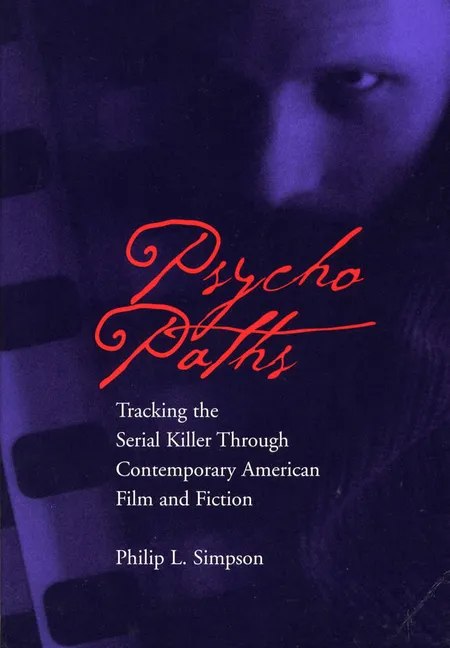
Psycho Paths
Tracking the Serial Killer Through Contemporary American Film and Fiction
Report an issue
Tell us what's wrong and we'll take a look.
Thanks – we got it. We'll review and follow up if needed.
Philip L. Simpson provides an original and broad overview of the evolving serial killer genre in the two media most responsible for its popularity: literature and cinema of the 1980s and 1990s.
The fictional serial killer, with a motiveless, highly individualized modus operandi, is the latest manifestation of the multiple murderers and homicidal maniacs that haunt American literature and, particularly, visual media such as cinema and television. Simpson theorizes that the serial killer genre results from a combination of earlier genre depictions of multiple murderers, inherited Gothic storytelling conventions, and threatening folkloric figures reworked over the years into a contemporary mythology of violence. Updated and repackaged for mass consumption, the Gothic villains, the monsters, the vampires, and the werewolves of the past have evolved into the fictional serial killer, who clearly reflects American cultural anxieties at the start of the twenty-first century.
Citing numerous sources, Simpson argues that serial killers' recent popularity as genre monsters owes much to their pliability to any number of authorial ideological agendas from both the left and the right ends of the political spectrum. Serial killers in fiction are a kind of debased and traumatized visionary, whose murders privately and publicly re-empower them with a pseudo-divine aura in the contemporary political moment. The current fascination with serial killer narratives can thus be explained as the latest manifestation of the ongoing human fascination with tales of gruesome murders and mythic villains finding a receptive audience in a nation galvanized by the increasingly apocalyptic tension between the extremist philosophies of both the New Right and the anti-New Right.
Faced with a blizzard of works of varying quality dealing with the serial killer, Simpson has ruled out the catalog approach in this study in favor of in-depth an analysis of the best American work in the genre. He has chosen novels and films that have at least some degree of public name-recognition or notoriety, including Red Dragon and The Silence of the Lambs by Thomas Harris, Manhunter directed by Michael Mann, Henry: Portrait of a Serial Killer directed by John McNaughton, Seven directed by David Fincher, Natural Born Killers directed by Oliver Stone, Zombie by Joyce Carol Oates, and American Psycho by Bret Easton Ellis.
Philip L Simpson
Philip L. Simpson is vice president of Academic and Student Affairs at Eastern Florida State College on the Space Coast of Florida. He serves as co-chair of the Stephen King Area for the Popular Culture Association, chair of the Endowment Committee for the Popular Culture Association, and editorial board member of The Journal of American Culture. He has published numerous books, book chapters, and journal articles on film, literature, popular culture, and horror, as well as short fiction.
More by Philip L Simpson


Why Readwise Books?
Readwise Books is an ebook & audiobook platform that automatically logs how much you and your friends read, making it fun and easy to read more. Learn more →