Report an issue
Tell us what's wrong and we'll take a look.
Thanks – we got it. We'll review and follow up if needed.
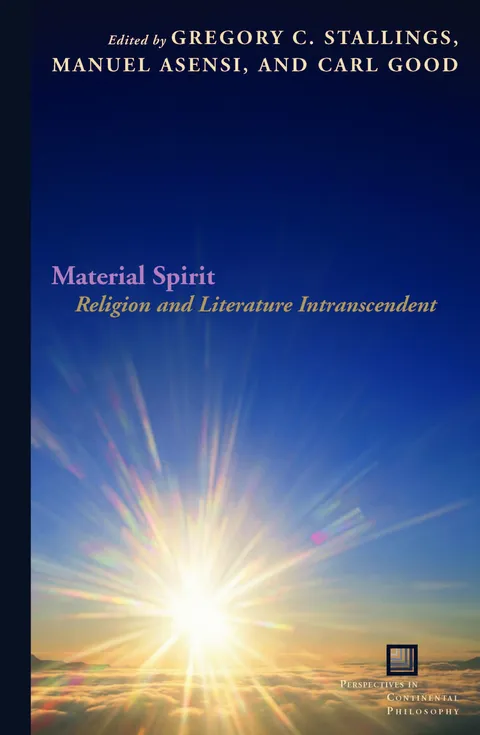
The essays in this collection examine philosophical, religious, and literary or artistic texts using methodologies and insights that have grown out of reflection on literature and art. In them, them phrase “material spirit” becomes a point of departure for considering the continuing spectral effects of religious texts and concerns in ways that do not simply call for, or assume, new orrenewed forms of religiosity.
The writers in this collection seek to examine religion beyond traditional notions of transcendence: Their topics range from early Christian religious practices to global climate change. Some of the essays explore religious themes or tones in literary texts, for example, works by Wordsworth, Hopkins, Proust, Woolf, and Teresa of Avila. Others approach—in a literarycritical
mood—philosophical or para-philosophical writers such as Bataille, Husserl, Derrida, and Benjamin. Still others treat writers of a more explicitly religious orientation, such as Augustine, Rosenzweig, or Bernard of Clairvaux.
Manuel Asensi
Manuel Asensi is professor and chair of the Department of Literary Theory at the University of Valencia, Spain. His work focuses on literary theory, literature, film studies, and mystical poetry. He is the author of numerous books of criticism, including Crítica y sabotaje (Anthropos/Siglo XXI, 2011) (currently being translated into English as Sabotage Critique), Los años salvajes de la teoría: Philippe Sollers, Tel Quel y la génesis del pensamiento post-estructural francés (The Savage Years of Theory: Sollers, Tel Quel and the Genesis of French Poststructuralism) (Tirant lo Blanch,2004), J. Hillis Miller or Boustrophedonic Reading/Others (with J. Hillis Miller, Stanford University Press,1999), and Literatura y filosofía (Literature and Philosophy) (Sintesis,1995). He has also written a three-volume history of literary theory, published by Editorial Tirant lo Blanch, and several monographs on Cervantes, Derrida, Hitchcock, and early German Romanticism.
More by Manuel Asensi
Carl Good
Carl Good previously served as a Spanish professor at Emory University and Indiana University Bloomington and currently works as an independent academic translator and editor. He has published on colonial and contemporary Hispanic literature, including articles on Cervantes and Sor Juana.


Why Readwise Books?
Readwise Books is an ebook & audiobook platform that automatically logs how much you and your friends read, making it fun and easy to read more. Learn more →