Report an issue
Tell us what's wrong and we'll take a look.
Thanks – we got it. We'll review and follow up if needed.
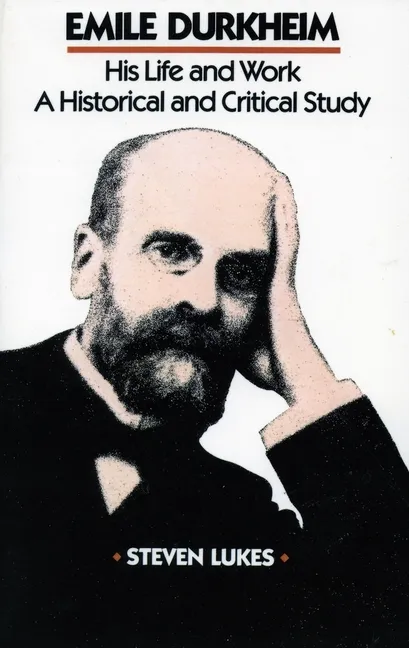
This study of Durkheim seeks to help the reader to achieve a historical understanding of his ideas and to form critical judgments about their value. To some extent these tow aims are contradictory. On the one hand, one seeks to understand: what did Durkheim really mean, how did he see the world, how did his ideas related to one another and how did they develop, how did they related to their biographical and historical context, how were they received, what influence did they have and to what criticism were they subjected, what was it like not to make certain distinctions, not to see certain errors, of fact or of logic, not to know what has subsequently become known?
On the other hand, one seeks to assess: how valuable and how valid are the ideas, to what fruitful insights and explanations do they lead, how do they stand up to analysis and to the evidence, what is their present value? Yet it seems that it is only by inducing oneself not to see and only by seeing them that one can make a critical assessment. The only solution is to pursue both aims--seeing and not seeing--simultaneously. More particularly, this book has the primary object of achieving that sympathetic understanding without which no adequate critical assessment is possible. It is a study in intellectual history which is also intended as a contribution to sociological theory.
Steven Lukes
Steven Lukes is Professor of Sociology at NYU. He has previously taught at the London School of Economics and the University of Siena, and is the author of numerous works including Emile Durkheim: His Life and Work, Power: A Radical View and What is Left?
More by Steven Lukes


Why Readwise Books?
Readwise Books is an ebook & audiobook platform that automatically logs how much you and your friends read, making it fun and easy to read more. Learn more →