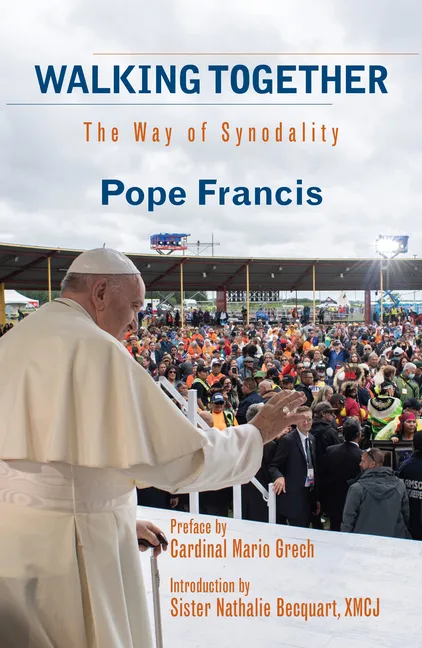
Walking Together: The Way of Synodality
Report an issue
Tell us what's wrong and we'll take a look.
Thanks – we got it. We'll review and follow up if needed.
"Synodality is not a chapter in an ecclesiology textbook, much less a fad or a slogan to be bandied about in our meetings. Synodality is an expression of the Church's nature, her form, style, and mission."--Pope Francis
The word "synodality" means "journeying together." To Pope Francis, a commitment to synodality has been one of the defining themes of his papacy, and an essential dimension of his intended legacy for the Roman Catholic Church. Synodality, he says, is not something the Church does--but an expression of its being: walking together, listening, and collaborating under the guidance of the Holy Spirit.
Regular "synods" of bishops have gathered since Vatican II to address concerns of the universal church. But Pope Francis has wished to open this process more widely to the People of God. In a process begun in 2021 which will conclude with a gathering of church leadership in October 2023 and 2024--a Synod on Synodality--Francis seeks to enable a church and church structures that are defined less from the top-down, and more through the participation of all members of the Church in a spirit of collaboration and openness.
Along with Pope Francis's principal reflections on this theme, Walking Together includes reflections by Cardinal Mario Grech, the Secretary of the Synod of Bishops, and Sister Nathalie Becquart, undersecretary of the General Secretariat of the Synod of Bishops.
Pope Francis
Pope Francis (Jorge Mario Bergoglio) was born in Buenos Aires in 1936, the son of a railwayman. He joined the Society of Jesus (Jesuits) at the age of 21 and was ordained a priest in 1969. He was elected Archbishop of Buenos Aires in 1998 and was created cardinal by Pope John Paul II in 2001 with the title of cardinal priest of San Roberto Bellarmino. He was elected the 266th Pope in March 2013.
More by Pope Francis


Why Readwise Books?
Readwise Books is an ebook & audiobook platform that automatically logs how much you and your friends read, making it fun and easy to read more. Learn more →