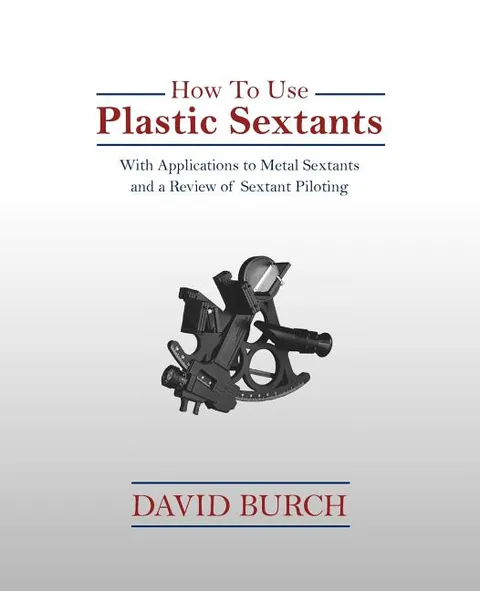
How to Use Plastic Sextants
With Applications to Metal Sextants and a Review of Sextant Piloting
Report an issue
Tell us what's wrong and we'll take a look.
Thanks – we got it. We'll review and follow up if needed.
Sextants are used to measure angular heights of celestial bodies above the horizon to find the latitude and longitude of the observer. They can also be used on land with artificial horizons. Sextants can also be used to find the correct Universal Time by measuring the angular distance between the moon and another body along its path across the zodiac. In coastal waters or on land, sextants can be used for very accurate piloting by measuring the horizontal angles between charted landmarks. The vertical angle of a peak above its baseline determines the distance to it, which, combined with a compass bearing, yields a position fix from just one landmark. The angular dip of an object (island or vessel) below the visible horizon can also be used to determine the distance to it. This booklet explains how to get the best results from plastic sextants, and presents numerical comparisons with similar data from metal sextants. Sextant piloting techniques are also reviewed as they are an ideal use of a plastic sextant.
David Burch
David Burch is a renowned expert on navigation with severalsuccessful titles and a high profile in the boating community. The founderand director of the Starpath School of Navigation, Burch holds a Ph.D. inphysics and has more than 60,000 miles of ocean sailing experience.
More by David Burch


Why Readwise Books?
Readwise Books is an ebook & audiobook platform that automatically logs how much you and your friends read, making it fun and easy to read more. Learn more →