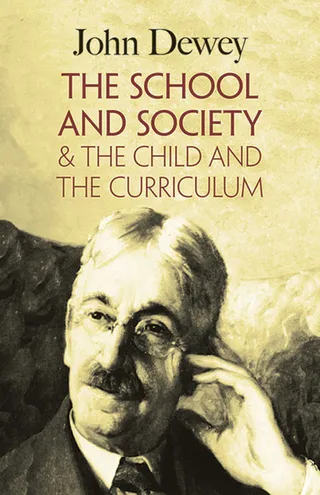
The School and Society
Lectures on Education; the Role of Play, the Life and Psychology of the Child, and the Aims of Teaching History
Report an issue
Tell us what's wrong and we'll take a look.
Thanks – we got it. We'll review and follow up if needed.
Educational reformer John Dewey discusses the role of the school in the modern society, detailing how teaching deeply influences the lives of individual children, and the entire society thereby.
Several lively and engaging chapters concern topics such as the components of the sound education. Throughout, the author seeks to dispel preconceptions and extinguish limitations of understanding that commonly underpin analyses about the educational system. While Dewey harks back to the distant past, in reviewing and acknowledging the contributions of German innovator Friedrich Froebel, he also notes what has worked in the education system from the vantage point of the 20th century.
For the author, a society without a correctly organized, well-run and well-funded educational system is one defined by waste - in the sense of squandering the talents of its children, and in the sense of the society being impaired. The variety of schools present is important, that education pertinent to a wide variety of pursuits - scientific, practical or cerebral - be accomplished. The ideals of culture, personal conduct and acquisition of knowledge should reflect not merely set curricula, but the wider aims and accomplishments of society.
John Dewey
John Dewey was the most famous teacher of philosophy in the early twentieth century, and he was known for his lifelong work to reform America’s educational system. Dewey was born in Burlington, Vermont, in 1859 to strict Calvinist parents. After graduating from the University of Vermont, Dewey taught high school and studied philosophy in his spare time. He finished his doctorate degree at Johns Hopkins University and continued to teach at various universities around the country, finally landing at Columbia University. While in New York, Dewey became involved in political groups and founded what would become the progressive education movement, which purported that students should learn to think for themselves to become active participants of a democratic society. He was also a founding member of the NAACP and ACLU. At this time, Dewey was influenced by Karl Marx, and after traveling to different countries to study their educational systems, praised Soviet education and came under scrutiny in the United States. Dewey continued his political and philosophical efforts until his death in 1952.
More by John Dewey


Why Readwise Books?
Readwise Books is an ebook & audiobook platform that automatically logs how much you and your friends read, making it fun and easy to read more. Learn more →