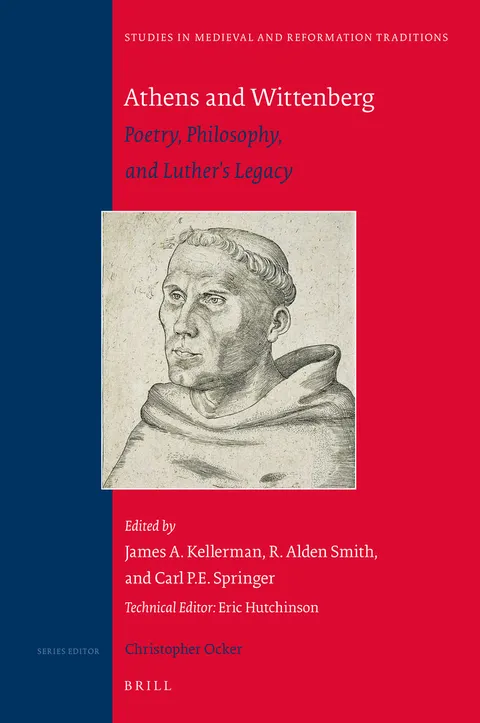
Athens and Wittenberg
Poetry, Philosophy, and Luther's Legacy
Report an issue
Tell us what's wrong and we'll take a look.
Thanks – we got it. We'll review and follow up if needed.
Scholarship has tended to assume that Luther was uninterested in the Greek and Latin classics, given his promotion of the German vernacular and his polemic against the reliance upon Aristotle in theology. But as Athens and Wittenberg demonstrates, Luther was shaped by the classical education he had received and integrated it into his writings. He could quote Epicurean poetry to non-Epicurean ends; he could employ Aristotelian logic to prove the limits of philosophy's role in theology. This volume explores how Luther and early Protestantism, especially Lutheranism, continued to draw from the classics in their quest to reform the church. In particular, it examines how early Protestantism made use of the philosophy and poetry from classical antiquity.
Contributors to this volume: Joseph Herl, Jane Schatkin Hettrick, E.J. Hutchinson, Jack D. Kilcrease, E. Christian Kopf, John G. Nordling, Piergiacomo Petrioli, Eric G. Phillips, Richard J. Serina, Jr, R. Alden Smith, Carl P.E. Springer, Manfred Svensson, William P. Weaver, and Daniel Zager.
James A Kellerman
James A. Kellerman (Ph.D., Loyola University-Chicago) serves as pastor of First Bethlehem Lutheran Church in Chicago, Illinois, and as adjunct assistant professor of Latin at Concordia University-Chicago.
Carl P E Springer
Carl P.E. Springer, Ph.D. (1984, University of Wisconsin-Madison) is SunTrust Chair of Excellence in the Humanities at the University of Tennessee Chattanooga. He has written extensively on the relationship between Martin Luther and the Classics, including Luther's Aesop (Kirksville, 2011).


Why Readwise Books?
Readwise Books is an ebook & audiobook platform that automatically logs how much you and your friends read, making it fun and easy to read more. Learn more →