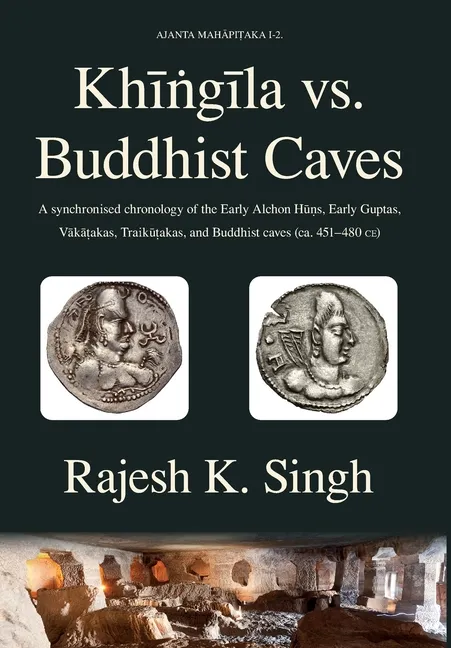
Khingila vs. Buddhist Caves
A synchronised chronology of the Early Alchon Huns, Early Guptas, Vakatakas, Traikutakas, and Buddhist caves (ca. 451-480 CE)
Report an issue
Tell us what's wrong and we'll take a look.
Thanks – we got it. We'll review and follow up if needed.
This monograph is meant for the researchers of South Asian studies with a focussed interest on the history and art of the late fifth century CE.
The new study proposes a reconstructive chronology of the times. It clarifies that the fifth-century rock-cut monuments of India were all Buddhist with only a few exceptions. The excavations had begun in the peaceful times of circa 461/462 CE. However, by circa 480 CE all the cave temples were abandoned even before completion. The study re-examines the cause of the abandonment and presents some new revelations.
It was ca. 465 CE when the Hephthalite Hūṇs attacked the Early Alchon Hūṇs in the Greater Gandhāra region forcing the Buddhist monks to disperse inter alia towards the Deccan, which was then peaceful. Many
Buddhist rock-cut sites were flourishing there under the Gupta-Vākāṭaka-Traikūṭakas: Bagh, Ajanta, Ellora, Mahāḍ, Dhārāśiva (Jain), Banoṭī, Ghaṭotkaca, Nasik, Loṇāḍ, Kondavite, and Kanheri.
The ousted Alchons led by Mahāṣāhi Khīṅgīla (r. ca. 440 to 492-496 CE) advanced into India and came up to the Narmada-Tapti valleys. The new intrusions witnessed many battles, particularly those of ca. 469, 472, and 477 CE wherein many great Indian emperors and kings were perished: Kumāragupta I, Nāgabhaṭa, Ghaṭōtkacagupta, Skandagupta, Narasimhagupta, Narendra Sena, Ravisāmba, Kumāragupta II, Hari Ṣeṇa, and Dahrasena.
These disturbances in India now forced the migrant Gandhāran and the resident Deccani monks to escape to distant lands including Kucha in Central Asia. Consequently, there was catalysed the Kuchean Period III, which witnessed the introduction of many Gandhāran and Deccani ideas.
Finally Buddhagupta ousted the Alchons in ca. 478 CE. The persistent defeat had taught the Alchons a lesson. They now imbibed the Indian values of liberalism as statecraft, which allowed them unobstructed rule for the next one century and two decades (ca. 479-ca. 600 CE) when they ruled from Greater Gandhāra to the Narmada valley.
The new picture comes out when we attempt to synchronise and iron out the anachronisms from the known chronologies of the Early Alchons, Early Guptas, Vākāṭakas, Traikūṭakas, Gandhāra, and the rock-cut monuments of India and Kucha in the late 5th century CE. It is revealed that the monasteries were abandoned due to the attacks by the Early Alchon Hūṇs.
Rajesh Kumar Singh
Dr. Rajesh Kumar Singh is currently working as a Research Associate in Banaras Hindu University. His research focus is pharmacognosy, reverse pharmacology, drug design and discovery, extraction & isolation of natural products, cell culture, and handling of different rodents. He has published several research articles in reputable journals over the course of his career. At present, he is involved in developing an Indian origin cell line and screening drugs of natural origin for the treatment of gallbladder cancer.
More by Rajesh Kumar Singh







Why Readwise Books?
Readwise Books is an ebook & audiobook platform that automatically logs how much you and your friends read, making it fun and easy to read more. Learn more →