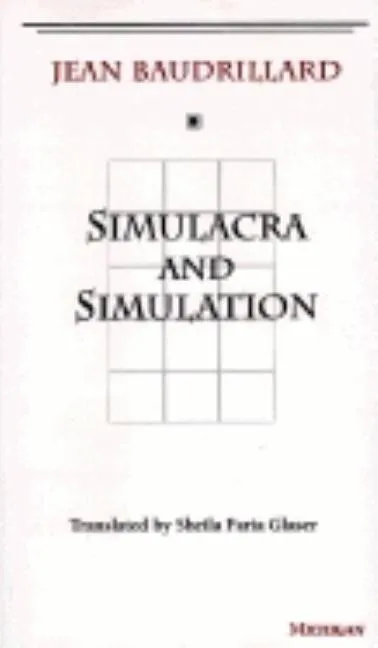
Simulacra and Simulation
Report an issue
Tell us what's wrong and we'll take a look.
Thanks – we got it. We'll review and follow up if needed.
This foundational work in postmodern philosophy and cultural theory explores how contemporary society has replaced reality and meaning with symbols and signs, leading to a condition Baudrillard calls "hyperreality." In his provocative treatise, Baudrillard examines the implications of a world where simulations (copies without originals) precede and shape what we consider real, blurring the boundary between reality and representation. Through analysis of mass media, consumer culture, and technological influence, he argues that modern life is dominated by "simulacra," images and concepts that no longer refer to any authentic reality but instead reference each other, creating an endless cycle of signification detached from truth. With references ranging from Disneyland to the news media, this book offers a challenging critique of how people in the late twentieth century and beyond perceive, construct, and interact with the world, underlining the instability of meaning in a media-saturated culture.
Jean Baudrillard
Jean Baudrillard (1929-2007) began teaching sociology at the Universit� de Paris-X in 1966. He retired from academia in 1987 to write books and travel until his death in 2007. His many works include Simulations and Simulacra, America, The Perfect Crime, The System of Objects, Passwords, The Transparency of Evil, The Spirit of Terrorism, and Fragments, among others.
More by Jean Baudrillard







Why Readwise Books?
Readwise Books is an ebook & audiobook platform that automatically logs how much you and your friends read, making it fun and easy to read more. Learn more →