
Indian Thoughts and Its Development
Report an issue
Tell us what's wrong and we'll take a look.
Thanks – we got it. We'll review and follow up if needed.

I have written this short account of Indian Thought and its Development in the hope that it may help people in Europe to become better acquainted than they are at present with the ideas it stands for and the great personalities in whom these ideas are embodied. To gain an insight into Indian thought, and to analyse it and discuss our differences, must necessarily make European thought clearer and richer. If we really want to understand the thought of India we must get clear about the problems it has to face and how it deals with them. What we have to do is to set forth and explain the process of development it has passed through from the time of the Vedic hymns down to the present day. I am fully conscious of the difficulty of describing definite lines of development in a philosophy which possesses in so remarkable a degree the will and the ability not to perceive contrasts as such, and allows ideas of heterogeneous character to subsist side by side and even brings them into connection with each other. But I believe that we, the people of the West, shall only rightly comprehend what Indian thought really is and what is its significance for the thought of all mankind, if we succeed in gaining an insight into its processes.
Albert Schweitzer
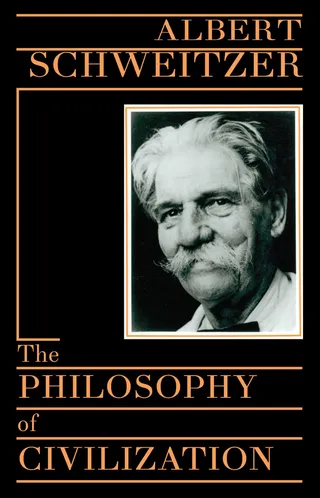
Albert Schweitzer, OM (14 January 1875 – 4 September 1965) was a German—and later French—theologian, organist, philosopher, physician, and medical missionary in Africa, also known for his interpretive life of Jesus. He was born in the province of Alsace-Lorraine, at that time part of the German Empire. He considered himself French and wrote in French. Schweitzer, a Lutheran, challenged both the secular view of Jesus as depicted by historical-critical methodology current at his time in certain academic circles, as well as the traditional Christian view. He received the 1952 Nobel Peace Prize for his philosophy of “Reverence for Life”, expressed in many ways, but most famously in founding and sustaining the Albert Schweitzer Hospital in Lambaréné, now in Gabon, west central Africa (then French Equatorial Africa). As a music scholar and organist, he studied the music of German composer Johann Sebastian Bach and influenced the Organ reform movement (Orgelbewegung).
More by Albert Schweitzer











Why Readwise Books?
Readwise Books is an ebook & audiobook platform that automatically logs how much you and your friends read, making it fun and easy to read more. Learn more →