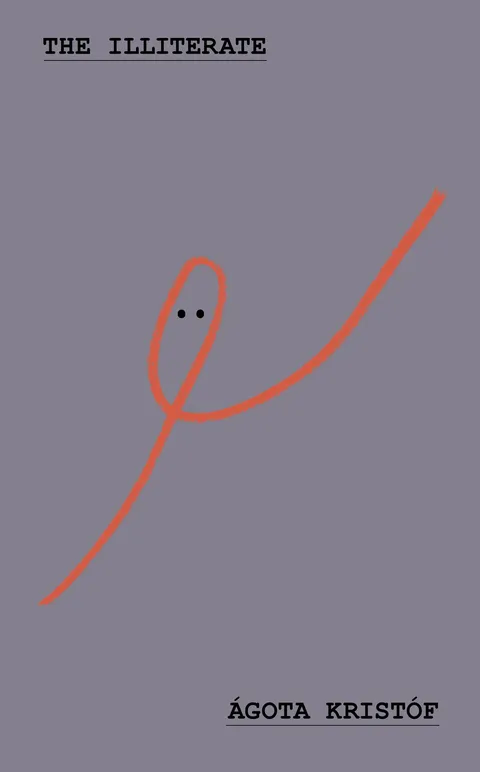
The Illiterate
Report an issue
Tell us what's wrong and we'll take a look.
Thanks – we got it. We'll review and follow up if needed.
In 2004, late in her legendary career, Ágota Kristóf wrote this slim dagger of a memoir about being a refugee after fleeing Hungary in 1956
Narrated in a series of stark, brief vignettes, The Illiterate is Ágota Kristóf’s memoir of her childhood, her escape from Hungary in 1956 with her husband and small child, her early years working in factories in Switzerland, and the writing of her first novel, The Notebook. Few writers can convey so much in so little space. Fierce yet almost pointedly flat and documentarian in tone, Kristóf portrays with a disturbing level of detail and directness an implacable message of loss: first, she is forced to learn Russian as a child (with the Soviet takeover of Hungary, Russian became obligatory at school); next, at age twenty-one, she finds herself required to learn French to survive: I have spoken French for more than thirty years, I have written in French for twenty years, but I still don’t know it. I don’t speak it without mistakes, and I can only write it with the help of dictionaries, which I frequently consult. It is for this reason that I also call the French language an enemy language. There is a further reason, the most serious of all: this language is killing my mother tongue.Ágota Kristóf
Ágota Kristóf was born in Hungary in 1935, and moved to Switzerland when she was twenty-one. Besides the three-part novel for which she is best-known—The Notebook, The Proof, and Third Lie—her books include Yesterday and The Illiterate. A winner of the Gottfried Keller Award and the Austrian State Prize for European Literature, Kristóf died in Neuchâtel in 2011.
More by Ágota Kristóf


Why Readwise Books?
Readwise Books is an ebook & audiobook platform that automatically logs how much you and your friends read, making it fun and easy to read more. Learn more →