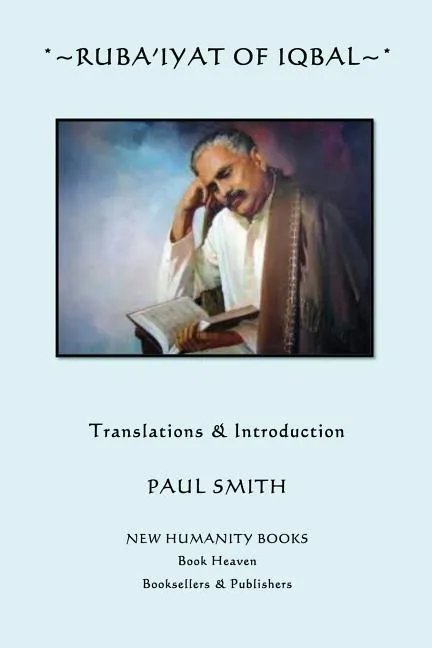
Ruba'iyat of Iqbal
Report an issue
Tell us what's wrong and we'll take a look.
Thanks – we got it. We'll review and follow up if needed.
RUBA'IYAT OF IQBAL Translation & Introduction by Paul Smith Muhammad Iqbal (1873-1938) was born in Sialkot, Punjab. He graduated from Government College, Lahore with a master's degree in philosophy. He taught there while he established his reputation as an Urdu poet. During this period his poetry expressed an ardent Indian nationalism, but a marked change came over his views when he was studying for his doctorate at Cambridge, visiting German universities and qualifying as a barrister. The philosophies of Nietzsche and Bergson influenced him and he became critical of Western civilization that he regarded as decadent. He turned to Islam and Sufism for inspiration and rejected nationalism as a disease of the West. These ideas found expression in his long poems written in Persian, presumably to gain his ideas an audience in the Moslem world outside India. Becoming convinced that Muslims were in danger from the Hindu majority if India should become independent, he gave his support to Jinnah as the leader of India's Muslims. He is perhaps the last great master of the famous four-line ruba'i form of poetry, having composed over 550 of them in Persian & Urdu. Here is the largest collection of his ruba'is in English in book form, in the correct rhyme-structure and meaning. Introduction on his life, times & poetry and the form, function & history of the ruba'i. Bibliography. 175 pages. COMMENTS ON PAUL SMITH'S TRANSLATION OF HAFIZ'S 'DIVAN'."It is not a joke... the English version of ALL the ghazals of Hafiz is a great feat and of paramount importance. I am astonished. " Dr. Mir Mohammad Taghavi (Dr. of Literature) Tehran."Superb translations. 99% Hafiz 1% Paul Smith." Ali Akbar Shapurzman, translator from English into Persian, knower of Hafiz's Divan off by heart."Smith has probably put together the greatest collection of literary facts and history concerning Hafiz." Daniel Ladinsky (Penguin Books author). Paul Smith is a poet, author and translator of over 140 books of Sufi poets of Persian, Arabic, Urdu, Turkish, Pashtu and other languages... including Hafiz, Sadi, Nizami, Rumi, 'Attar, Sana'i, Jahan Khatun, Obeyd Zakani, Mu'in, Amir Khusrau, Nesimi, Kabir, Anvari, Ansari, Jami, Khayyam, Rudaki, Yunus Emre, Lalla Ded, Bulleh Shah and many others, as well as his own poetry, fiction, plays, biographies, children's books and a dozen screenplays. amazon.com/author/smithpa

Paul Smith
Translated by
Paul Smith is Professor of Cultural Studies and Global Affairs at George Mason University. Most of his working life has been spent in the US, including posts at Miami University OH, and Carnegie Mellon before his appointment at George Mason University in 1996. Between 1999 and 2002 he was chaired Professor and department head of Media and Cultural Studies at the University of Sussex. At George Mason he has been director of the Center for the Study of the Americas and currently teaches mostly in the Cultural Studies PhD program, but also for Global Affairs. He was elected President of the national Cultural Studies Association (2016-18). He is the author of Pound Revised, Discerning the Subject, Clint Eastwood: A Cultural Production, Millennial Dreams: Culture and Capital in the North, and Primitive America: The Ideology of Capitalist Democracy. He has edited Men in Feminism (with Alice Jardine), Madonnarama (with Lisa Frank), and Boys, and has published a book of translations from Jean Louis Schefer, The Enigmatic Body. His essays and articles have appeared in scores of journals and collections in the US and overseas. His most recent edited volume is The Renewal of Cultural Studies and he is currently completing a book on Covid vaccines.


Why Readwise Books?
Readwise Books is an ebook & audiobook platform that automatically logs how much you and your friends read, making it fun and easy to read more. Learn more →