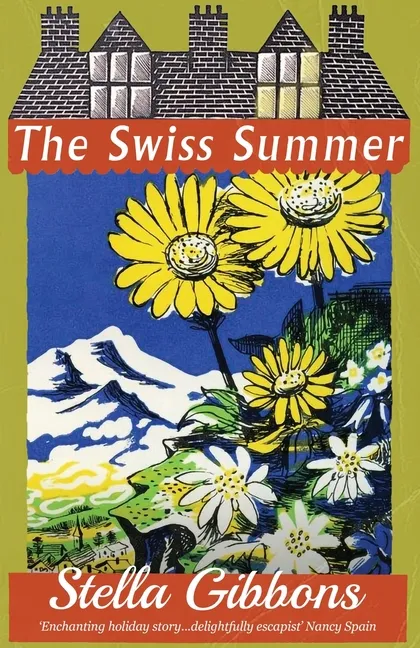
The Swiss Summer
Report an issue
Tell us what's wrong and we'll take a look.
Thanks – we got it. We'll review and follow up if needed.
Nevertheless, within three weeks from that very day she was seated in the train; leaving London, leaving her life in England with every detail arranged and every foreseeable mishap foreseen and guarded against-and pinned on her coat was a bunch of gentians given to her in loving farewell by her husband-and she was on her way to the Alps.
Worn down by postwar London life, forty-something Lucy Cottrell finds herself accepting a surprise invitation to spend the summer at a Swiss chalet, accompanied by the very practical and undemonstrative Freda Blandish, whom she barely knows. The two are charged with inventorying the contents of the chalet, but distractions soon abound, first from Freda's slightly woebegone daughter Astra and her hoity-toity friend Kay, then from Lucy's godson Bertram and his friend Peter. Utta, the housekeeper, determined to prevent any changes to the chalet she loves, and a challenging paying guest add complications, as do clashing personalities, misunderstandings, and budding romance-not to mention a bit of Alpine climbing.
Packed with good humour, lush scenery, and irresistible charm, The Swiss Summer, first published in 1951, is one of Stella Gibbons' most delightful novels. This new edition features an introduction by twentieth-century women's historian Elizabeth Crawford.
'For holiday reading it would be hard to find anything better.' Guardian
Stella Gibbons
Stella Gibbons was born in 1902 in London. She was educated first at home, then the North London Collegiate School for Girls, and finally at University College, London, where she did a two-year course on journalism. Her first job, in 1923, was as cable decoder for British United Press. For the next decade she worked as a London journalist for various publications, including the Evening Standard and The Lady. Her first published book was a volume of poems in 1930. This was followed by the classic comic novel Cold Comfort Farm (1932) which remains her best-known work. In 1933 she met and married Allan Webb, an actor and singer, the marriage lasting until the latter's death in 1959. From 1934 until 1970, Stella Gibbons published more than twenty further novels, in addition to short stories and poetry, and there were two further posthumously-published full-length works of fiction. She was a fellow of the Royal Society of Literature, and was awarded a Femina Vie-Heureuse prize in 1933 for Cold Comfort Farm. Stella Gibbons died on December 19, 1989, at home in London.
More by Stella Gibbons


Why Readwise Books?
Readwise Books is an ebook & audiobook platform that automatically logs how much you and your friends read, making it fun and easy to read more. Learn more →