Report an issue
Tell us what's wrong and we'll take a look.
Thanks – we got it. We'll review and follow up if needed.
Environmental information and responses are processed very fast to support quick decision making in relation to people's survival and benefits. Environmental Psychology explains the environmental types people prefer and why certain environments make people feel, for example, anxious or excited. Understanding people's emotional responses to the environment facilitates, or "nudges" (a term usually used in the inter-discipline of Psychology and Behavioral Economics), users to act or make choices as desired. Moreover, research on attention in cognitive sciences can also inform designers: by controlling the spatial elements and intangible elements (such as light and sound) to minimize environmental disturbance or noise, users' attention can be directed to specific elements, element combinations or series. During this process, users' specific emotional memories or symbolic implications are activated, which augments desired feelings and experiences.
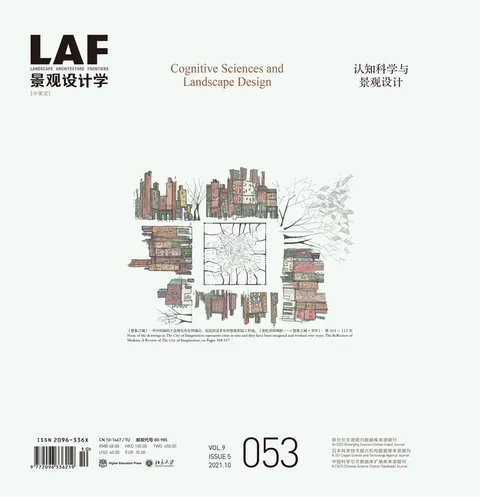
This issue explores the mechanism of how landscape design affects users' feelings, experiences, and behaviors, as well as usability, by introducing theories, knowledge, and research methods and findings in Cognitive sciences, psychology, neurobiology, and computer science, so as to support landscape architects' decision making.
Kongjian Yu
Kongjian Yu is a doctor of design at the Graduate School of Design, Harvard University, he is an honorary foreign fellow of the American Academy of Arts and Sciences, and a professor at the College of Architecture and Landscape Architecture, Peking University.


Why Readwise Books?
Readwise Books is an ebook & audiobook platform that automatically logs how much you and your friends read, making it fun and easy to read more. Learn more →