Report an issue
Tell us what's wrong and we'll take a look.
Thanks – we got it. We'll review and follow up if needed.
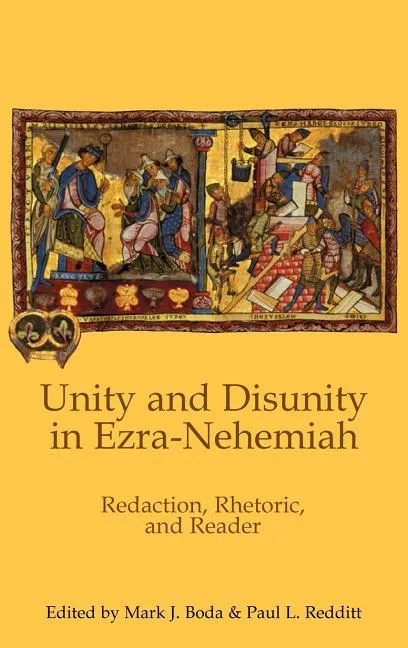
Until the late 1960s the scholarly consensus was that Chronicles-Ezra-Nehemiah was a single, unified literary work. Then arguments began to be mounted for treating Chronicles as a distinct composition, and the majority of scholars were swayed by these arguments, though others retained the older consensus view. In recent years, some scholars have begun to suggest that Ezra and Nehemiah are distinct literary entities. This new debate is the occasion for the present volume. Here scholars from around the globe (Canada, Finland, Germany, Guatemala, Israel, Korea, the Netherlands, United Kingdom, United States) showcase current scholarly explanations for the final shape of this literary complex known as Ezra-Nehemiah. Fourteen scholars present their approach to the unity or disunity of this literature employing research methodologies that range from the diachronic to the synchronic. Critical responses to this emerging research are provided by three reviewers (Joseph Blenkinsopp, Tamara Eskenazi and Hugh Williamson) whose work laid the foundation in earlier decades for much of the discussion today. The result is a rich conversation which provides an enlightening resource for the study of these biblical books in particular as well as for reflection on the impact of one's interpretive framework on the study of ancient literature in general.
Mark J Boda
Mark J. Boda (PhD, University of Cambridge) is professor of Old Testament at McMaster Divinity College in Hamilton, Ontario. He is the author or editor of more than thirty books, including The Heartbeat of Old Testament Theology, the Dictionary of the Old Testament: Prophets (coedited with J. Gordon McConville), and commentaries on Haggai, Zechariah, 1-2 Chronicles, and Judges.
Paul L Redditt
Prof. Dr. Paul L. Redditt is professor emeritus at Georgetown College, Kentucky.


Why Readwise Books?
Readwise Books is an ebook & audiobook platform that automatically logs how much you and your friends read, making it fun and easy to read more. Learn more →