Report an issue
Tell us what's wrong and we'll take a look.
Thanks – we got it. We'll review and follow up if needed.
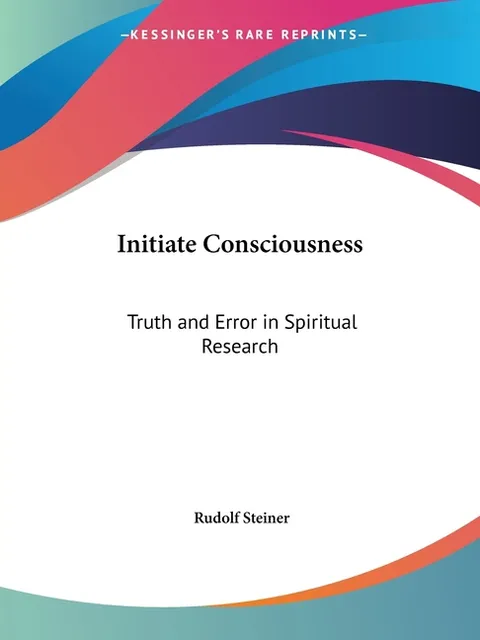
Initiate Consciousness: Truth and Error in Spiritual Research is a book written by Rudolf Steiner, a philosopher and spiritualist who founded the Anthroposophical movement. The book is a collection of lectures that were delivered by Steiner in 1923, and it explores the concept of initiate consciousness, which is a state of spiritual awakening that allows individuals to access higher levels of consciousness and gain insight into the spiritual realm.Throughout the book, Steiner discusses the importance of spiritual research and the dangers of relying solely on external sources of knowledge. He argues that true spiritual understanding can only be achieved through direct experience and inner exploration, and he provides practical guidance for those seeking to develop their own initiate consciousness.Steiner also explores the concept of truth and error in spiritual research, emphasizing the importance of discernment and critical thinking in the pursuit of spiritual knowledge. He warns against the dangers of dogmatism and blind faith, and encourages readers to approach spiritual research with an open and questioning mind.Overall, Initiate Consciousness: Truth and Error in Spiritual Research is a thought-provoking and insightful book that offers valuable guidance for anyone seeking to deepen their understanding of spirituality and consciousness.1924. Contents: Know Thyself; Nature is the Great Illusion; Three Worlds and their Reflections; States of Human Consciousness; Metamorphosis of Consciousness; Vitalizing the Soul; Initiation Knowledge; Spiritual Research; Influence of Extraterrestrial Cosmos on Human Consciousness; plus more!This scarce antiquarian book is a facsimile reprint of the old original and may contain some imperfections such as library marks and notations. Because we believe this work is culturally important, we have made it available as part of our commitment for protecting, preserving, and promoting the world's literature in affordable, high quality, modern editions, that are true to their original work.
Rudolf Steiner
Rudolf Steiner (1861-1925) was born in the small village of Kraljevec, Austro-Hungarian Empire (now in Croatia), where he grew up. As a young man, he lived in Weimar and Berlin, where he became a well-published scientific, literary, and philosophical scholar, known especially for his work with Goethe's scientific writings. At the beginning of the twentieth century, he began to develop his early philosophical principles into an approach to systematic research into psychological and spiritual phenomena. Formally beginning his spiritual teaching career under the auspices of the Theosophical Society, Steiner came to use the term Anthroposophy (and spiritual science) for his philosophy, spiritual research, and findings. The influence of Steiner's multifaceted genius has led to innovative and holistic approaches in medicine, various therapies, philosophy, religious renewal, Waldorf education, education for special needs, threefold economics, biodynamic agriculture, Goethean science, architecture, and the arts of drama, speech, and eurythmy. In 1924, Rudolf Steiner founded the General Anthroposophical Society, which today has branches throughout the world. He died in Dornach, Switzerland.
More by Rudolf Steiner







Why Readwise Books?
Readwise Books is an ebook & audiobook platform that automatically logs how much you and your friends read, making it fun and easy to read more. Learn more →