Report an issue
Tell us what's wrong and we'll take a look.
Thanks – we got it. We'll review and follow up if needed.
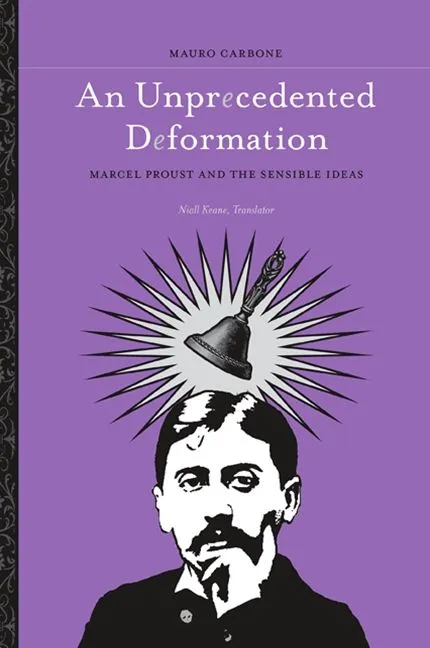
Philosophical interpretation of Proust based on the work of Merleau-Ponty and Deleuze.
French novelist Marcel Proust made famous "involuntary memory," a peculiar kind of memory that works whether one is willing or not and that gives a transformed recollection of past experience. More than a century later, the Proustian notion of involuntary memory has not been fully explored nor its implications understood. By providing clarifying examples taken from Proust's novel and by commenting on them using the work of French philosophers Maurice Merleau-Ponty and Gilles Deleuze, Italian philosopher Mauro Carbone interprets involuntary memory as the human faculty providing the involuntary creation of our ideas through the transformation of past experience. This rethinking of the traditional way of conceiving ideas and their genesis as separated from sensible experience-as has been done in Western thought since Plato-allows the author to promote a new theory of knowledge, one which is best exemplified via literature and art much more than philosophy.
Mauro Carbone
Mauro Carbone is Professor of Aesthetics at the Faculté de Philosophie of the University Jean Moulin Lyon 3 and an Honorary Member of the Institut Universitaire de France. He is the founder and the coeditor of the journal Chiasmi International: Trilingual Studies Concerning Merleau-Ponty’s Thought. His present research focuses on the connections between philosophy and contemporary visual experience. Among his books are The Flesh of Images: Merleau-Ponty between Painting and Cinema (SUNY Press, 2015) and Philosophy-Screens: From Cinema to Digital Revolution (SUNY Press, 2019).
More by Mauro Carbone


Why Readwise Books?
Readwise Books is an ebook & audiobook platform that automatically logs how much you and your friends read, making it fun and easy to read more. Learn more →