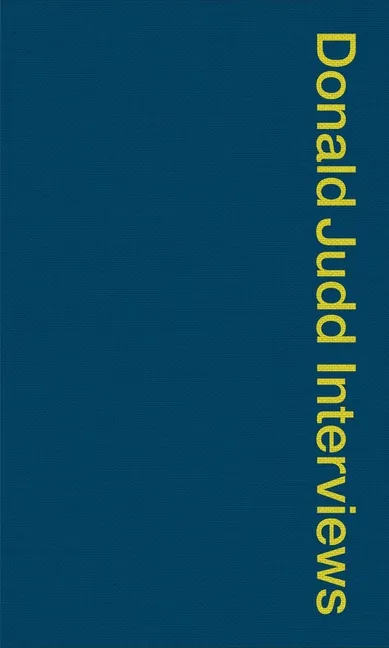
Donald Judd Interviews
Report an issue
Tell us what's wrong and we'll take a look.
Thanks – we got it. We'll review and follow up if needed.
This collection of interviews engages a diverse range of topics, from philosophy and politics to Judd's insightful critiques of his own work and the work of others such as Mark di Suvero, Edward Hopper, Yayoi Kusama, Barnett Newman, and Jackson Pollock. The opening discussion of the volume between Judd, Dan Flavin, and Frank Stella provides the foundation for many of the succeeding conversations, focusing on the nature and material conditions of the new art developing in the 1960s. The publication also gathers a substantial body of unpublished material across a range of mediums including extensive interviews with art historians Lucy R. Lippard and Barbara Rose.
Judd's contributions in interviews, panels, and extemporaneous conversations are marked by his forthright manner and rigorous thinking, whether in dialogue with art critics, art historians, or his contemporaries. In one of the last interviews, he observed, "Generally expensive art is in expensive, chic circumstances; it's a falsification. The society is basically not interested in art. And most people who are artists do that because they like the work; they like to do that [make art]. Art has an integrity of its own and a purpose of its own, and it's not to serve the society. That's been tried now, in the Soviet Union and lots of places, and it doesn't work. The only role I can think of, in a very general way, for the artist is that they tend to shake up the society a little bit just by their existence, in which case it helps undermine the general political stagnation and, perhaps by providing a little freedom, supports science, which requires freedom. If the artist isn't free, you won't have any art."
Donald Judd Interviews is co-published by Judd Foundation and David Zwirner Books. The interviews expand upon the artist's thinking present in Donald Judd Writings (Judd Foundation/David Zwirner Books, 2016).
Donald Judd
With the intention of creating straightforward work that could assume a direct material and physical "presence" without recourse to grand philosophical statements, Donald Judd (1928-1994) eschewed the classical ideals of representational sculpture to create a rigorous visual vocabulary that sought clear and definite objects as its primary mode of articulation.
More by Donald Judd


Why Readwise Books?
Readwise Books is an ebook & audiobook platform that automatically logs how much you and your friends read, making it fun and easy to read more. Learn more →