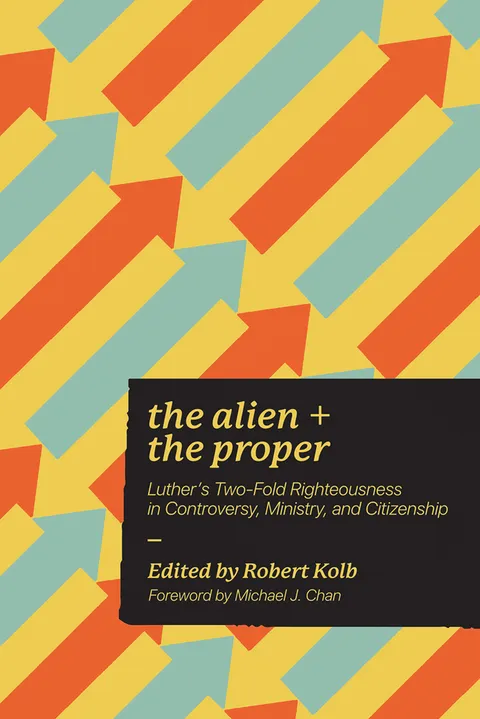
Alien and the Proper
Luther's Two-Fold Righteousness in Controversy, Ministry, and Citizenship
Report an issue
Tell us what's wrong and we'll take a look.
Thanks – we got it. We'll review and follow up if needed.
"This book probes the beating theological heart of Luther's evangelical theology." -- Michael J. Chan, Ph.D., Concordia College
In his Galatians commentary of 1535, Martin Luther insists that "our theology" relies on the proper distinction of two kinds of righteousness: Alien and Proper. In relation to our Creator, we freely receive our "alien" righteousness from Christ who has obtained it for us through his death and resurrection. In relation to humanity and God's created order, we practice a "proper" righteousness by actively fulfilling God's commands that set down the form and pattern for good human living.
The Alien and the Proper "helps us to appropriate Luther's theology as our theology as well." -- Mark Mattes, Lutheran Bible Institute Chair of Theology, Grand View University
Luther posited that this distinction was the key to understanding our humanity. His regular use of this anthropological principle, particularly when applied to justification by faith, the nature of sin, and the proper practice of God's gift of humanity, demonstrates its centrality and importance.
In The Alien and the Proper, five authors examine the historical development of Luther's Twofold Righteousness and propose ways in which it can continue to serve Christians today. Through these essays you will learn about Luther's radical divergence from medieval theological formulations, and you will discover what it means to be human.
Essays by:
- David A. Lumpp
- Charles P. Arand
- William W. Schumacher
- Joel Biermann
- Timothy Saleska
- Robert Kolb (editor)
Robert Kolb
Robert Kolb is a theology professor who teaches at Concordia Seminary in Saint Louis and has spent much of his career studying and teaching about Martin Luther. He has taught internationally in post-Soviet Europe, received multiple honorary degrees, and written many books on Christian faith and history.


Why Readwise Books?
Readwise Books is an ebook & audiobook platform that automatically logs how much you and your friends read, making it fun and easy to read more. Learn more →