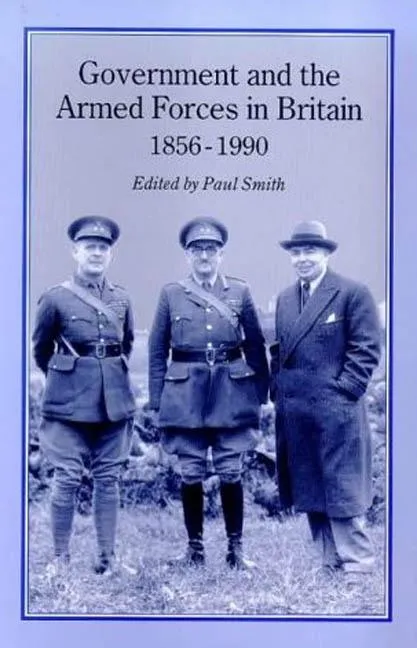
Government & Armed Forces in Britain, 1856-1990
Report an issue
Tell us what's wrong and we'll take a look.
Thanks – we got it. We'll review and follow up if needed.
In a period that began with Britain controlling a world-wide empire and included two world wars, followed by the Cold War and massive expenditure on nuclear armaments, the relationship between the politicians and the generals has been central to British history. While it is correctly assumed that the Armed Forces have never threatened British political stability in modern times, the relationship between the military and their political masters is a major, if under-emphasised, theme of British history. While in theory the politicians decided strategy and the military implemented it, in practice decisions often depended on the personalities and experience of those involved. Asquith, the epitome of the civilian, left major strategic decisions in the hands of the military; while Churchill, an ex-soldier and ex-First Lord of the Admiralty, rode roughshod over professional military advice. In a period when arms before ever more technologically sophisticated, there was also the problem of how far politicians could decide on strategies proposed by the military other than by the crude yardstick of cost. The essays in Government and the Armed Forces in Britain, 1856--1990 provide a coherent account not only of the major decision-making of warfare but also of the changes in the organisation and control of the Armed Forces.
Paul Smith
Paul Smith was educated at Andover Grammar School and Balliol College, Oxford. After research at St. Antony's College, Oxford, he taught at the Queen's University of Belfast, and is now Lecturer in History at King's College, London. He received his doctorate from Oxford 1965.


Why Readwise Books?
Readwise Books is an ebook & audiobook platform that automatically logs how much you and your friends read, making it fun and easy to read more. Learn more →