Report an issue
Tell us what's wrong and we'll take a look.
Thanks – we got it. We'll review and follow up if needed.
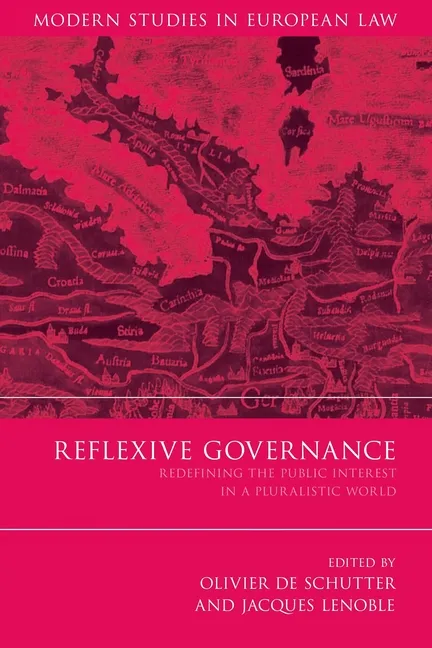
Reflexive governance offers a theoretical framework for understanding modern patterns of governance in the European Union (EU) institutions and elsewhere. It offers a learning-based approach to governance, but one which can better respond to concerns about the democratic deficit and to the fulfillment of the public interest than the currently dominant neo-institutionalist approaches. The book is composed of one general introduction and eight chapters. Chapter one introduces the concept of reflexive governance and describes the overall framework. The following chapters of the book then summarise the implications of reflexive governance in major areas of domestic, EU and global policy-making. They address in turn: Services of General Interest, Corporate Governance, Institutional Frames for Markets, Regulatory Governance, Fundamental Social Rights, Healthcare Services, Global Public Services and Common Goods. While the themes are diverse, the chapters are unified by their attempt to get to the heart of which concepts of governance are dominant in each field, and what their successes and failures have been: reflexive governance then emerges as one possible response to the failures of other governance models currently being relied upon by policy-makers.
Olivier de Schutter
Olivier De Schutter is the former UN Special Rapporteur on the right to food (2008-14) and a member of the UN Committee on Economic, Social and Cultural Rights. A professor at the University of Louvain (UCL) and at the College of Europe and a Member of the Global Law School Faculty at New York University, he has been Visiting Professor at a number of institutions, including Columbia University (2008-13). From 2002 to 2006, he chaired the EU Network of Independent Experts on Fundamental Rights, a high-level group of experts which advised the European Union institutions on fundamental rights issues. He has acted on a number of occasions as expert for the Council of Europe and for the European Union. Between 2004 and 2008, he was the General Secretary of the International Federation of Human Rights (FIDH) on the issue of globalization and human rights.
More by Olivier de Schutter




Why Readwise Books?
Readwise Books is an ebook & audiobook platform that automatically logs how much you and your friends read, making it fun and easy to read more. Learn more →