
Report an issue
Tell us what's wrong and we'll take a look.
Thanks – we got it. We'll review and follow up if needed.
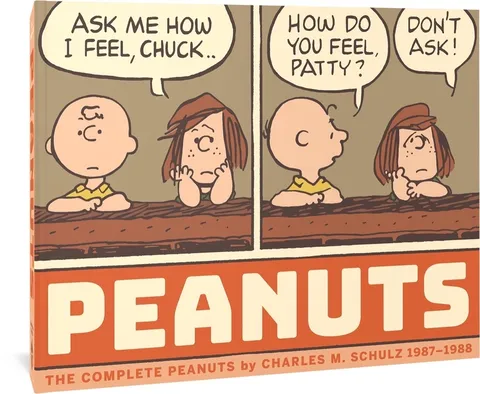
So what do we have for Peanuts fans this time around? An ill-considered attempt at flirting sends Charlie Brown to the school doctor... Linus's ongoing romance with the too-young "Lydia" of the many names continues... Snoopy is joined in the trenches by his brother Spike... Sally engages in a career as a playwright by penning the school Christmas play but mixes up Gabriel and Geronimo... A hockey mishap sends Snoopy to the doctor for knee surgery, in a (clearly autobiographical) sequence that lasts only until everyone figures out that dogs don't have knees... Linus and Lucy's kid brother Rerun begins to take on the greater role that will lead to him being one of the dominant characters in the 1990s... and Snoopy, inevitably, writes a "kiss and tell" book. As we reach the 19th (!) book in this epochal, best-selling series collecting arguably the greatest comic strip of all time and head toward the end of the 1980s, Charles Schulz is still as inventive, hilarious, and touching as ever... and this volume even features a surprise format change, as the daily strip switches from its trademark four-square-panels format to a more flexible one-to-four-variable-panels format which, along with Schulz's increased use of gray tones, give this volume a striking, distinctive look.
Charles M. Schulz
From his earliest memories, Charles M. Schulz knew that all he wanted to do was “draw funny pictures.” Schulz was born in Minneapolis, Minnesota, in 1922, and his love for cartoons was fostered by his father in a shared appreciation for the Sunday funnies. As a senior in high school, at the prompting of his mother, he completed a correspondence cartoon course with the Federal School of Applied Cartooning. Schulz continued his studies in art as the genre of the cartoon began to change—adopting simplistic, minimalistic styles that, conveniently, allowed Schulz to showcase his dry, self-effacing humor. In 1943 Schulz enlisted in the army to help the American efforts in World War II, ultimately returning home in the fall of 1945. In a push to make his dream of being a cartoonist a reality, he taught at his alma mater and sold cartoon strips to papers intermittently. Finally, in October 1950, the first Peanuts strip premiered in seven national newspapers. His seemingly simple creation—illustrations of large-headed kids using vocabulary and facing situations far beyond their years—became a well-known, well-loved comic strip and grew to have an enormous global impact. Schulz himself has won awards from his cartoonist peers, has been recognized and lauded by U.S. and foreign governments, and has received Emmys for his animated specials. In 2015 the beloved holiday TV special—A Charlie Brown Christmas—will reach its fifty-year milestone. Though the last original Peanuts comic appeared in papers on February 13, 2000, the day after Schulz passed away in his sleep, his work continues to be read in more than two thousand newspapers around the world.
More by Charles M. Schulz







Why Readwise Books?
Readwise Books is an ebook & audiobook platform that automatically logs how much you and your friends read, making it fun and easy to read more. Learn more →