The Book of Good Counsels
Report an issue
Tell us what's wrong and we'll take a look.
Thanks – we got it. We'll review and follow up if needed.
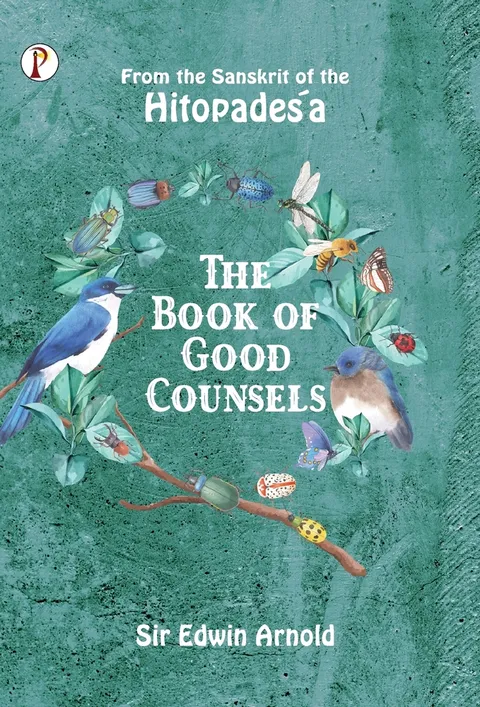
Structured as a guide for young princes, the narratives in "The Book of Good Counsels" weave together humor, irony, and profound insight. Each section explores a different facet of human behavior, using the trials and triumphs of creatures like the crow, the mouse, and the lion to illustrate complex moral dilemmas. This work remains a significant contribution to world literature, offering a window into the rich oral and written traditions of classical India. Readers will find in its pages a blend of folklore and philosophy that continues to resonate as a testament to the enduring power of storytelling as a vehicle for ethical education.
This work has been selected by scholars as being culturally important, and is part of the knowledge base of civilization as we know it. This work was reproduced from the original artifact, and remains as true to the original work as possible. Therefore, you may see the original copyright references, library stamps (as most of these works have been housed in our most important libraries around the world), and other notations in the work.
This work is in the public domain in the United States of America, and possibly other nations. Within the United States, you may freely copy and distribute this work, as no entity (individual or corporate) has a copyright on the body of the work.
As a reproduction of a historical artifact, this work may contain missing or blurred pages, poor pictures, errant marks, etc. Scholars believe, and we concur, that this work is important enough to be preserved, reproduced, and made generally available to the public. We appreciate your support of the preservation process, and thank you for being an important part of keeping this knowledge alive and relevant.
Edwin Arnold
Sir. Edwin Arnold (10 June 1832 - 24 March 1904), was born in the United Kingdom. He was a journalist and poet, most popular as the writer of The Light of Asia (1879), which describes the life and lessons of Buddha. Pearls of the Faith (1883), on Islam, and The Light of the World (1891), on Christianity, got less success. After leaving the University of Oxford, Arnold became a schoolteacher in Birmingham, and later became principal of the British government college in Pune, India. He came back to Britain in 1861 to join the staff of the Daily Telegraph, where he worked as a chief editor from 1873 to 1889. He published various volumes of short poems, as well as translations of the Indian section and a good deal of travel composition. The essays collected in Japonica (1892) were a popular contribution to the late nineteenth-century (cult of Japan) in Britain, similar to his variations of Japanese poetry in The Tenth Muse (1895) and his Japanese play Adzuma (1893). He was knighted in 1888.
More by Edwin Arnold


Why Readwise Books?
Readwise Books is an ebook & audiobook platform that automatically logs how much you and your friends read, making it fun and easy to read more. Learn more →