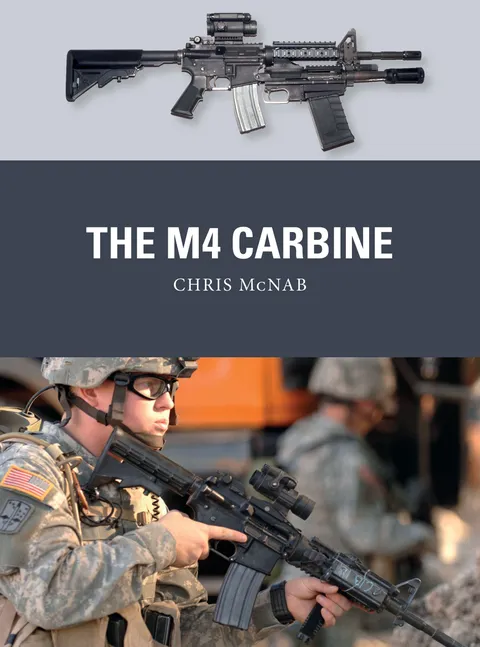
The M4 Carbine
Report an issue
Tell us what's wrong and we'll take a look.
Thanks – we got it. We'll review and follow up if needed.
Developed as a fusion of the XM177E2 Colt Commando and the M16A2 assault rifle, the M4 has been tested and proven in major combat operations worldwide.
This study describes the development process in detail, from production of the first XM4 prototypes in 1984 through numerous modified types until its official use as the M4 in 1994. 1lb lighter and 6in shorter than the standard M16A2, the M4 could still deliver precision semi-auto and full-auto firepower up to an effective range of 500m. Over time, its capabilities have been enhanced by the M4A1 modifications plus an extensive range of tactical accessories, including optical day/night sights, laser/infrared designators, under-barrel grenade launchers and shotgun modules, foregrips, furniture options, mounting rails, and sound suppressors.
Numerous M4/M4A1 combat operations are investigated to reveal why the weapon has received such high levels of approval by front-line combat troops, not only in Afghanistan and Iraq, where the M4/M4A1 has been intensively combat-tested, but also in contexts such as Colombia, India, Israel, and the Philippines. Profusely illustrated with photographs and artworks, and drawing its research from recently declassified documents, this is a complete guide to one of the most important and widely distributed tactical infantry weapons of the last quarter-century.
Chris McNab
Dr Chris McNab is an author and historian, his principal subject areas being military history and military technology. He has written more than 100 non-fiction titles, including many Casemate pocket manuals relating to World War I, World War II, and the Vietnam War. Chris has appeared in several TV documentaries as an expert commentator, and he also works as an educational consultant, specializing in the development of textbooks and teaching materials.
More by Chris McNab










Why Readwise Books?
Readwise Books is an ebook & audiobook platform that automatically logs how much you and your friends read, making it fun and easy to read more. Learn more →