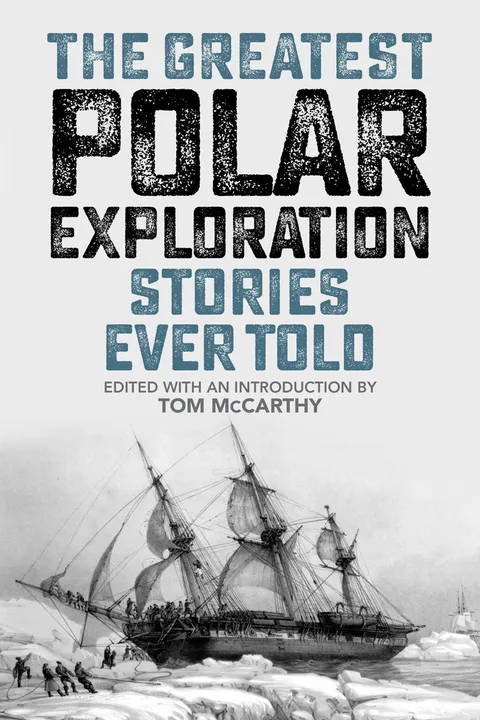
The Greatest Polar Exploration Stories Ever Told
Report an issue
Tell us what's wrong and we'll take a look.
Thanks – we got it. We'll review and follow up if needed.
The newspaper advertisement for volunteers to accompany Ernest Shackleton on his planned traverse of Antarctica in 1914 was frank in its offering.
"Men wanted for hazardous journey. Low wages, bitter cold, long hours of complete darkness. Safe return doubtful. Honour and recognition in event of success."
Still, hundreds applied. There were few chances left to be the first to reach the last challenge on Earth.
As the 20th Century came of age, explorers had uncovered most of the world's mysteries, sailing to the far corners of the globe, ascending many of its most forbidding peaks, crossing its greatest deserts and penetrating its thickest jungles.
Frozen, alien, inhospitable, dangerous, and close to impossible to reach, there were only two tiny dots on the globe that human beings had not yet set foot on--the North and South Poles.
The Greatest Polar Exploration Stories Ever Told is a visceral, exciting and stunning collection of twelve stories recounting the bravery, resoluteness, and strength of the men who willingly traversed frozen hells to be the first to reach the North or South Pole. It is a collection that will both inspire and inform--and answer questions about the limits of human endurance.
Many men would die during their challenging, frozen journeys, and their deaths were not pleasant. Yet they continued to try again.
Here are stories, wrought by the challenging landscape and weather, that made these explorers household names and heroes: Peary, Scott, Amundsen, Shackleton, Franklin, Cherry-Garrard, Scott, Kane, Cook--and others lost to history whose bravery was nonetheless as admirable.
Each of these men knew success would bring glory for their countries and financial security and fame and eminent places in history for themselves. Each knew also the odds of success were slim and the chance of dying great.
Nations held their collective breaths for news of each expedition and those years later were termed the Heroic Age of Exploration--there were simply no other endeavors that captured the world's attention the various races to the poles. The Greatest Polar Exploration Stories Ever Told recaptures the spirit, drama, and tragedy of a time in history that will never come again.
Tom McCarthy
Dr. Tom McCarthy, Panthera's Director of Snow Leopard Programs, began his conservation career studying brown bears, black bears, mountain goats and caribou in Alaska in the early 1980s. A strong interest in international conservation led him to Mongolia in 1992, where, under the guidance of Dr. George Schaller (known as "one of the founding fathers of wildlife conservation"), he took over the management of a long-term snow leopard research project. He was the first biologist to use satellite radio-collars on snow leopards. McCarthy became the Science and Conservation Director of the Snow Leopard Trust in 2000 and has since led their extensive science and community-based conservation programs across much of snow leopard range in Asia. From 2002-2009, Dr. McCarthy served as Executive Director of the Snow Leopard Network, a global consortium of more than 200 professionals involved in snow leopard research and conservation. Among other research initiatives, Dr. McCarthy is leading both a range-wide assessment of snow leopard genetics that seeks to identify movement corridors which are critical to maintaining the health and genetic diversity of the species, and a revision of methods by which snow leopard populations can be monitored over time, including such novel non-invasive approaches as fecal genetics, camera trapping and statistical modeling based on sign surveys.


Why Readwise Books?
Readwise Books is an ebook & audiobook platform that automatically logs how much you and your friends read, making it fun and easy to read more. Learn more →