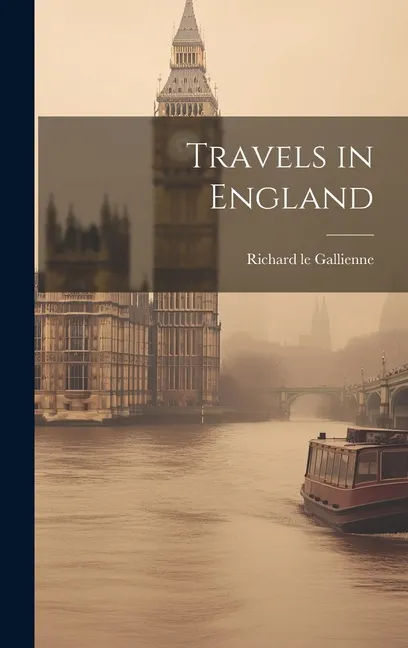
Travels in England
Report an issue
Tell us what's wrong and we'll take a look.
Thanks – we got it. We'll review and follow up if needed.
This delightful travelogue follows Richard Le Gallienne's adventures as he wanders through the landscapes, cities, and towns of England. With a keen eye for detail and a lyrical writing style, Le Gallienne captures the charm, beauty, and quirks of the English people and their culture. He offers insightful commentary on the history, architecture, and customs of the places he visits, providing readers with a unique perspective on England at the turn of the 20th century.
This work has been selected by scholars as being culturally important, and is part of the knowledge base of civilization as we know it.
This work is in the "public domain in the United States of America, and possibly other nations. Within the United States, you may freely copy and distribute this work, as no entity (individual or corporate) has a copyright on the body of the work.
Scholars believe, and we concur, that this work is important enough to be preserved, reproduced, and made generally available to the public. We appreciate your support of the preservation process, and thank you for being an important part of keeping this knowledge alive and relevant.
Richard Le Gallienne
Richard Le Gallienne was an English writer and poet. Eva Le Gallienne, a British-American actress, was his daughter from his second marriage to Danish journalist Julie Nørregaard (1863-1942). Richard Thomas Gallienne was born in West Derby, Liverpool, England, the eldest son of Jean ("John") Gallienne (1843-1929), manager of the Birkenhead Brewery, and his wife Jane (1839-1910), née Smith. He attended Liverpool College, which was an all-boys public school at the time. After finishing school, he changed his name to Le Gallienne and began working at an accountant's office in London. In 1883, his father took him to an Oscar Wilde lecture in Birkenhead. Mildred Lee, Richard's first wife, and Maria, their second daughter, died during childbirth in 1894, leaving Richard and their daughter Hesper Joyce. Following Mildred's death, he carried an urn holding her ashes with him at all times, including when married to his second wife. Rupert Brooke, who met Le Gallienne on a ship going for the United States in 1913 but did not warm to him, composed a brief poem called "For Mildred's Urn" to mock this behavior.
More by Richard Le Gallienne






Why Readwise Books?
Readwise Books is an ebook & audiobook platform that automatically logs how much you and your friends read, making it fun and easy to read more. Learn more →