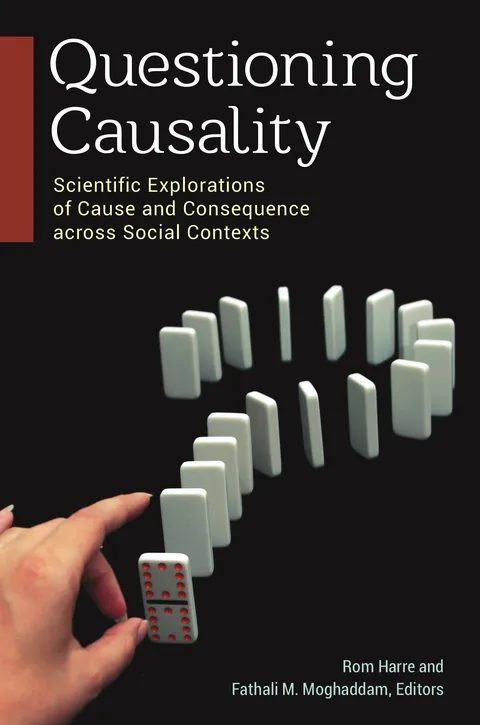
Questioning Causality
Scientific Explorations of Cause and Consequence across Social Contexts
Report an issue
Tell us what's wrong and we'll take a look.
Thanks – we got it. We'll review and follow up if needed.
Covering a topic applicable to fields ranging from education to health care to psychology, this book provides a broad critical analysis of the assumptions that researchers and practitioners have about causation and explains how readers can improve their thinking about causation.
In virtually every laboratory, research center, or classroom focused on the social or physical sciences today, the concept of causation is a core issue to be questioned, tested, and determined. Even debates in unrelated areas such as biology, law, and philosophy often focus on causality—"What made that happen?" In this book, experts from across disciplines adopt a reader-friendly approach to reconsider this age-old question in a modern light, defining different kinds of causation and examining how causes and consequences are framed and approached in a particular field. Each chapter uses applied examples to illustrate key points in an accessible manner.
The contributors to this work supply a coherent critical analysis of the assumptions researchers and practitioners hold about causation, and explain how such thinking about causation can be improved. Collectively, the coverage is broad, providing readers with a fuller picture of research in social contexts. Beyond providing insightful description and thought-provoking questioning of causation in different research areas, the book applies analysis of data in order to point the way to smarter, more efficient practices. Consequently, both practitioners and researchers will benefit from this book.
Fathali M. Moghaddam
Fathali Moghaddam is Professor and Director of the Interdisciplinary Program in Cognitive Science, Georgetown University, Washington, DC, and the editor of Peace and Conflict: Journal of Peace Psychology (a quarterly journal published by the American Psychological Association). Dr. Moghaddam was born in Iran, was educated from an early age in England, and worked for the United Nations and for McGill University before joining Georgetown in 1990. He returned to Iran in the "spring of revolution" in 1979 and was researching there during the hostage-taking crisis and the early years of the Iran-Iraq war. He has conducted experimental and field research in numerous cultural contexts and published extensively on radicalization, intergroup conflict, human rights and duties, the psychology of dictatorship and democracy, and causal explanations. He has received a number of prestigious academic awards, and his most recent books include The Psychology of Democracy (2016), The Psychology of Dictatorship (2013), and Questioning Causality: Scientific Explorations of Cause and Consequence Across Social Contexts (2016, with Rom Harré).


Why Readwise Books?
Readwise Books is an ebook & audiobook platform that automatically logs how much you and your friends read, making it fun and easy to read more. Learn more →