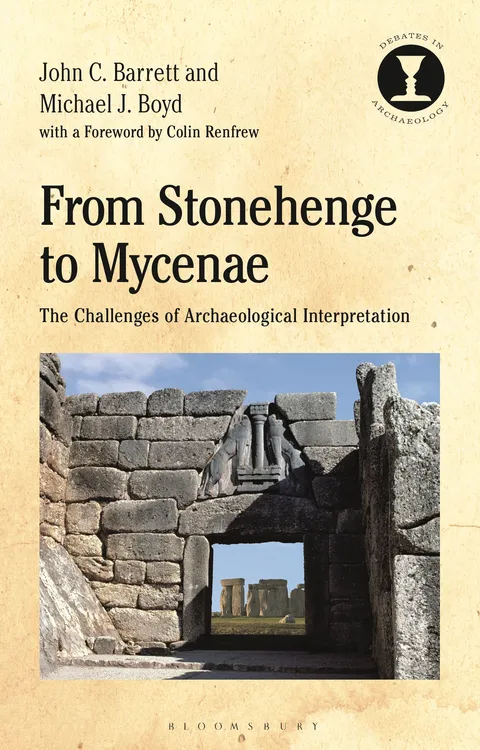
From Stonehenge to Mycenae
The Challenges of Archaeological Interpretation
Report an issue
Tell us what's wrong and we'll take a look.
Thanks – we got it. We'll review and follow up if needed.
This book reconsiders how we can understand archaeology on a grand scale by abandoning the claims that material remains stand for the people and institutions that produced them, or that genetic change somehow caused cultural change. Our challenge is to understand the worlds that made great projects like the building of Stonehenge or Mycenae possible. The radiocarbon revolution made the old view that the architecture of Mycenae influenced the building of Stonehenge untenable. But the recent use of 'big data' and of genetic histories have led archaeology back to a worldview where 'big problems' are assumed to require 'big solutions'.
Making an animated plea for bottom-up rather than top-down solutions, the authors consider how life was made possible by living in the local and materially distinct worlds of the period. By considering how people once built connections between each other through their production and use of things, their movement between and occupancy of places, and their treatment of the dead, we learn about the kinds of identities that people constructed for themselves. Stonehenge did not require an architect from Mycenae for it to be built, but the builders of Stonehenge and Mycenae would have shared a mutual recognition of the kinds of humans that they were, and the kinds of practices these monuments were once host to.
John Barrett
John Barrett is one of tennis's most respected historians, writers and broadcasters. A former British Davis Cup player and captain, he competed at Wimbledon for two decades before becoming one of the BBC's best-known tennis commentators. He was tennis correspondent of the Financial Times for more than 40 years and is a Vice-President of the All England Club. He was inducted into the International Tennis Hall of Fame in 2014.
More by John Barrett



Michael J. Boyd
Michael J. Boyd is a Senior Research Associate at the University of Cambridge, UK. His research interests lie in the prehistoric Aegean. He is co-director of excavations on Keros and co-editor of the Keros publications series. He has published a book on Mycenaean funerary practices, and has co-edited two collected volumes on funerary practices.
More by Michael J. Boyd


Why Readwise Books?
Readwise Books is an ebook & audiobook platform that automatically logs how much you and your friends read, making it fun and easy to read more. Learn more →