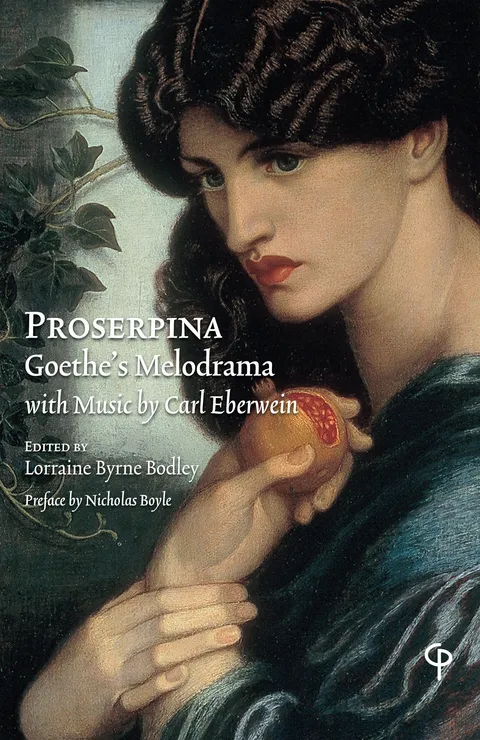
Proserpina
Goethe's Melodrama with Music by Carl Eberwein, Orchestral Score, Piano Reduction, and Translation
Report an issue
Tell us what's wrong and we'll take a look.
Thanks – we got it. We'll review and follow up if needed.
In his early twenties Goethe wrote Proserpina for the Weimar court singer Corona Schröter to perform. His interest in presenting Weimar’s first professional singer-inresidence in a favourable light was not the only reason why this monologue with music (now lost) by Seckendorff is important. Goethe’s memories of his sister Cornelia, who had recently died in childbirth, were in fact the real catalyst: through this work Goethe could level accusations against his parents about Cornelia’s marriage, of which he had not approved. Goethe used the melodramatic form to transform private and cultural issues for women of the time into public discourses and so to manipulate public opinion. His work reveals an astute understanding of musical melodrama and the important impact it had on the cultural dynamics of the late eighteenth and early nineteenth centuries.
Whatever the source of inspiration, it is clear that Goethe was very preoccupied with Proserpina. When he returned to this melodrama forty years later he collaborated closely with Carl Eberwein, the court, theatre, and church music director, who composed a new setting which accords with Goethe’s clear understanding of musical declamation in 19th century melodrama. In the intensive collaboration which took place while the production was being prepared in January 1815, Goethe was already anticipating the idea of a Gesamtkunstwerk. He paid close attention to every aspect of the production, especially to its music and its staging. When discussing contemporary settings of the poet’s works, scholars often lapse into regret that Goethe did not have someone of comparable rank at his side for musical collaborations. Yet Eberwein’s willingness to go along with Goethe’s wishes was an advantage here: the selfless striving of the young composer to satisfy the poet’s intentions is everywhere apparent in the score and it is the nearest thing we have to a ‘composition by Goethe’.
Despite critics’ positive reception of the first performance on 4 February 1815, the work has never been published before. Musically and dramatically this unknown melodrama is a superb work for solo voice, choir, and orchestra, and deserves to be brought before the public today.
Lorraine Byrne Bodley
Lorraine Byrne Bodley is professor of musicology at Maynooth University. In 2015 she was elected to The Royal Irish Academy and the first woman to be elected president of the Society for Musicology in Ireland for which she served two terms (2015-2021). In 2016 she was granted a personal chair in musicology at Maynooth University and was an invited Board Member of the Internationale Schubert-Gesellschaft (Tübingen and Vienna). In 2020 she was invited to be board member of the Kommission für Schubert Forschung (Schubert Research Centre, Vienna) at the Austrian Academy of Sciences and was also invited to be general editor with Harry White of the international book series Irish Musical Studies. She has published fifteen books, most recently a major revisionist biography of the composer Franz Schubert. She has published over fifty articles in peer-review journals and given over 150 keynote and guest lectures in Ireland and internationally.


Why Readwise Books?
Readwise Books is an ebook & audiobook platform that automatically logs how much you and your friends read, making it fun and easy to read more. Learn more →