
Utilitarianism
Report an issue
Tell us what's wrong and we'll take a look.
Thanks – we got it. We'll review and follow up if needed.
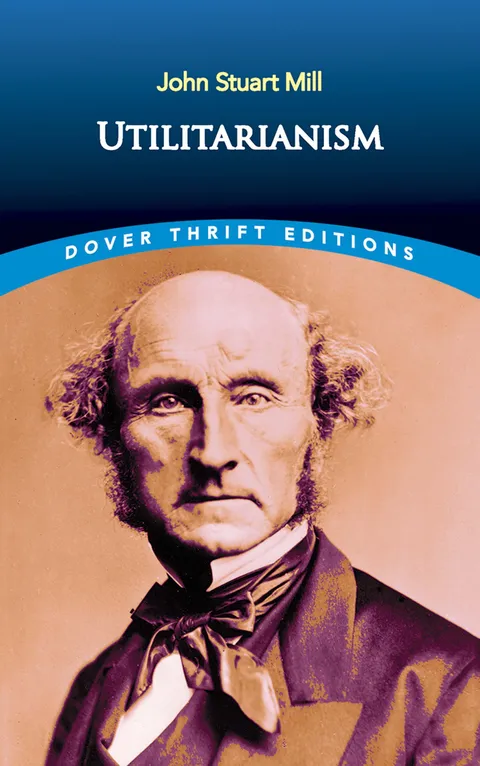

Utilitarianism is John Stuart Mill's classic exposition of the ethical theory that evaluates moral action according to its consequences for human happiness and well-being.
First published in 1863, the work sets out Mill's defence of utilitarian moral philosophy, refining and expanding upon the principles earlier advanced by Jeremy Bentham. Mill argues that actions are morally right insofar as they promote happiness, defined not merely as pleasure but as the cultivation of higher intellectual and moral capacities. He distinguishes qualitative differences in pleasures, asserting that moral judgment must account for depth, dignity, and long-term human flourishing.
Written with clarity and argumentative precision, Utilitarianism addresses common objections to consequentialist ethics while situating moral reasoning within social responsibility and collective welfare. The text has remained central to debates in moral philosophy, political theory, economics, and law. It continues to serve as a foundational work for students and readers seeking a rigorous introduction to nineteenth-century ethical thought and its lasting influence.
John Stuart Mill
John Stuart Mill was an English philosopher, politician and economist most famous for his contributions to the theory of utilitarianism. The author of numerous influential political treatises, Mill’s writings on liberty, freedom of speech, democracy and economics have helped to form the foundation of modern liberal thought. His 1859 work, On Liberty, is particularly noteworthy for helping to address the nature and limits of the power of the state over the individual. Mills has become one of the most influential figures in nineteenth-century philosophy, and his writings are still widely studied and analyzed by scholars. Mills died in 1873 at the age of 66.
More by John Stuart Mill








Why Readwise Books?
Readwise Books is an ebook & audiobook platform that automatically logs how much you and your friends read, making it fun and easy to read more. Learn more →