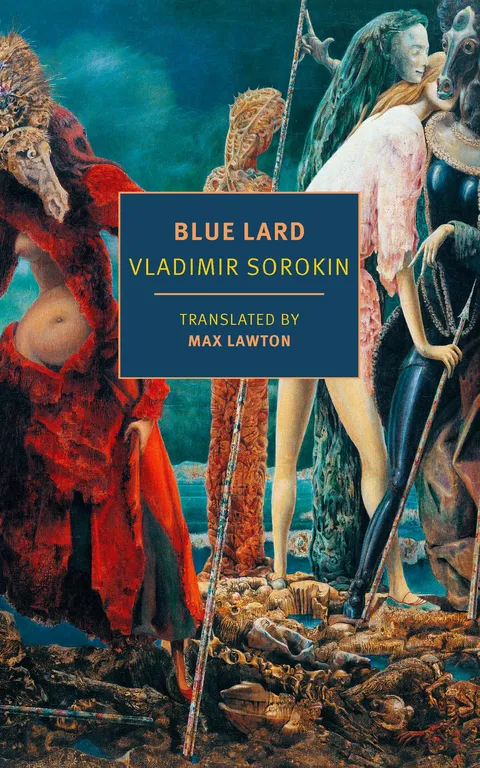
Blue Lard
Report an issue
Tell us what's wrong and we'll take a look.
Thanks – we got it. We'll review and follow up if needed.
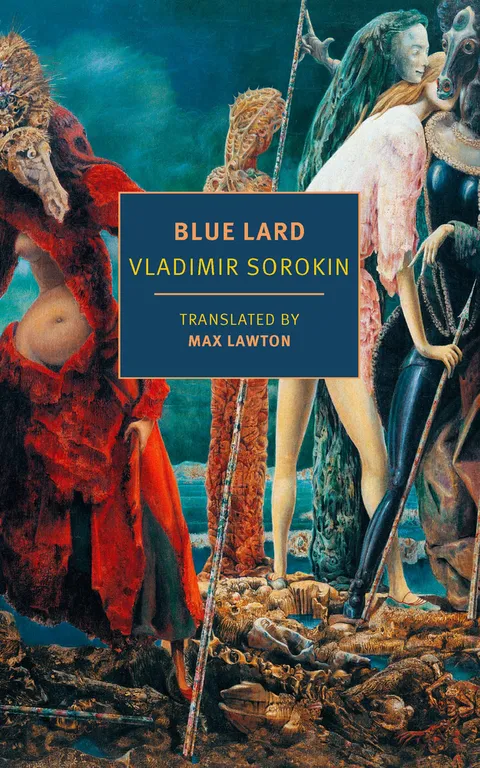
The Russian master's most infamous novel, a dystopian fever dream about cloning, alternative histories, and world domination.
Blue Lard is an act of desecration. Blue Lard is what's left after the towering masterpieces of Russian literature have been blown to smithereens, the most graphic, shocking, controversial, and celebrated book to be published in Russia since the end of Communism. Denounced as an abomination on publication in 1999—a crowd of angry Putin supporters gathered in front of Moscow’s Bolshoi Theater to toss shredded copies of Sorokin’s books into an enormous papier-mâché toilet—this ferocious takedown of Russian greatness has since found its way into the canon of Russian literature itself.
The book begins in a futuristic laboratory where genetic scientists speak in a dialect of Russian mixed with Chinese. There they work to clone famous Russian writers, who are then made to produce texts in the style of their forebears. The goal of this “script-process” is not the texts themselves but the blue lard that collects in the small of their backs as they write. This substance is to be used to power reactors on the moon—that is, until a sect of devout nationalists breaks in to steal the blue lard, planning to send it back in time to an alternate version of the Soviet Union, one that exists on the margins of a Europe conquered by a long-haired Hitler with the ability to shoot electricity from his hands. What will come of this blue lard? Who will finally make use of its mysterious powers?
Max Lawton’s translation of Blue Lard, the first into English, captures this key work in all its grotesque, havoc-making, horrifying, visceral intensity.
Vladimir Sorokin
Vladimir Sorokin was born in a small town outside of Moscow in 1955. He trained as an engineer at the Moscow Institute of Oil and Gas, but turned to art and writing, becoming a major presence in the Moscow underground of the 1980s. His work was banned in the Soviet Union, and his first novel, The Queue, was published by the famed émigré dissident Andrei Sinyavsky in France in 1983. In 1992, Sorokin's Collected Stories was nominated for the Russian Booker Prize; in 1999, the publication of the controversial novel Blue Lard, which included a sex scene between clones of Stalin and Khrushchev, led to public demonstrations against the book and to demands that Sorokin be prosecuted as a pornographer; in 2001, he received the Andrei Biely Award for outstanding contributions to Russian literature. Sorokin is also the author of the screenplays for the movies Moscow, The Kopeck, and 4, and of the libretto for Leonid Desyatnikov's Rosenthal's Children, the first new opera to be commissioned by the Bolshoi Theater since the 1970s. He has written numerous plays and short stories, and his work has been translated throughout the world. Among his most recent books are Sugar Kremlin and Day of the Oprichnik. He lives in Moscow.
More by Vladimir Sorokin





Why Readwise Books?
Readwise Books is an ebook & audiobook platform that automatically logs how much you and your friends read, making it fun and easy to read more. Learn more →