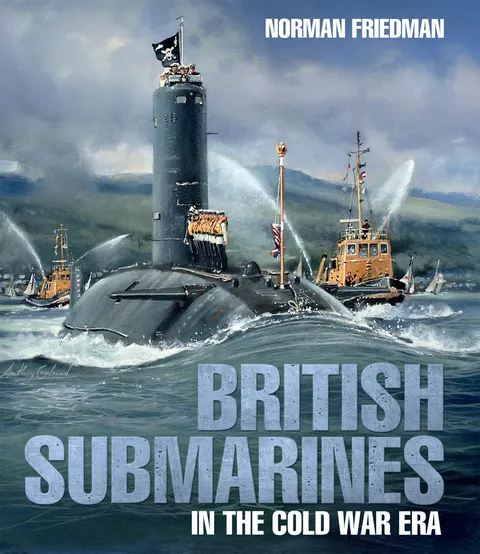
British Submarines in the Cold War Era
Report an issue
Tell us what's wrong and we'll take a look.
Thanks – we got it. We'll review and follow up if needed.
The first comprehensive technical history on the subject, with photos: "A must-read for all professionals, designers and scholars of modern submarines." —Australian Naval Institute The Royal Navy's greatest contribution to the Allied success in World War II was undoubtedly the defeat of the U-boat menace in the North Atlantic, a victory on which all other European campaigns depended. The underwater threat was the most serious naval challenge of the war, so it was not surprising that captured German submarine technology became the focus of attention for the British submarine service after 1945. It was quick to test and adopt the schnorkel, streamlining, homing torpedoes, and, less successfully, hydrogen-peroxide propulsion. Furthermore, in the course of the long Atlantic battle, the Royal Navy had become the world's most effective anti-submarine force and was able to utilize this expertise to improve the efficiency of its own submarines. However, in 1945 German submarine technology had also fallen into the hands of the Soviet Union—and as the Cold War developed it became clear that a growing Russian submarine fleet would pose a new threat. Britain had to go to the US for its first nuclear propulsion technology, but the Royal Navy introduced the silencing technique that made British and US nuclear submarines viable anti-submarine assets, and it pioneered in the use of passive—silent—sonars in that role. Nuclear power also changed the role of some British submarines, which replaced bombers as the core element of British Cold War and post-Cold War nuclear deterrence. As in other books in this series, this one shows how a combination of evolving strategic and tactical requirements and new technology produced successive types of submarines. It is based largely on unpublished and previously classified official documentation, and to the extent allowed by security restrictions, also tells the operational story—HMS Conqueror is still the only nuclear submarine to have sunk a warship in combat, but there are many lesser-known aspects of British submarine operations in the postwar era.
Norman Friedman
Norman Friedman is a prominent defense analyst and historian specializing in the intersection between policy, strategy, and technology, mainly in a naval context. He has published more than forty books. He is the recipient of numerous awards, including the Commodore Dudley W. Knox medal by the Naval Historical Foundation, the Samuel Eliot Morrison award by the Naval Order of the United States, the Westminster Prize awarded by the Royal United Service Institute, and the Anderson Medal of the British Society for Nautical Research. He has twice received the John Lyman Award from the North American Society for Oceanic History. He lives in New York City.
More by Norman Friedman



Why Readwise Books?
Readwise Books is an ebook & audiobook platform that automatically logs how much you and your friends read, making it fun and easy to read more. Learn more →