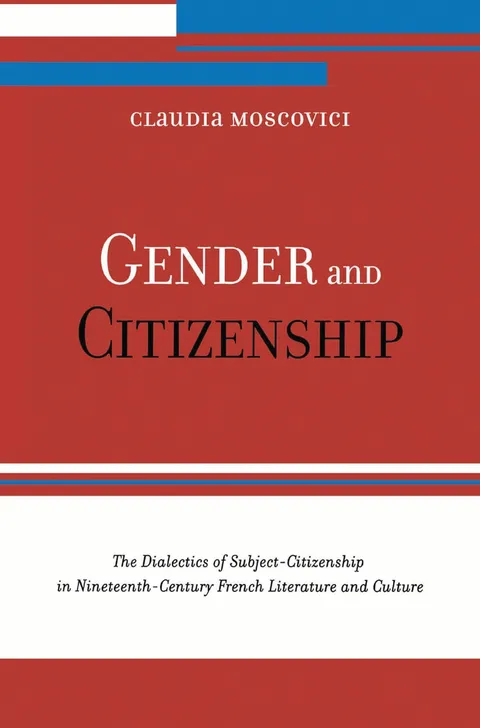
Gender and Citizenship
The Dialectics of Subject-Citizenship in Nineteenth Century French Literature and Culture
Report an issue
Tell us what's wrong and we'll take a look.
Thanks – we got it. We'll review and follow up if needed.
Moscovici proposes a new understanding of how gender relations were reformulated by both male and female writers in nineteenth-century France. She analyzes the different versions of gendered citizenship elaborated by Friedrich Hegel, George Sand, Honore de Balzac, Auguste Comte and Herculine Barbin revealing a shift from a single dialectical (or male-centered) definition of citizenship to a double dialectical (or bi-gendered) one in which each sex plays an important role in subject-citizenship and is defined as the negation of the other sex. Moscovici further argues that a double dialectical pattern of androgyny endows women with a (relational) cultural identity that secures their paradoxical roles as both representatives and outsiders to subject-citizenship in nineteenth-century French society and culture.






Why Readwise Books?
Readwise Books is an ebook & audiobook platform that automatically logs how much you and your friends read, making it fun and easy to read more. Learn more →