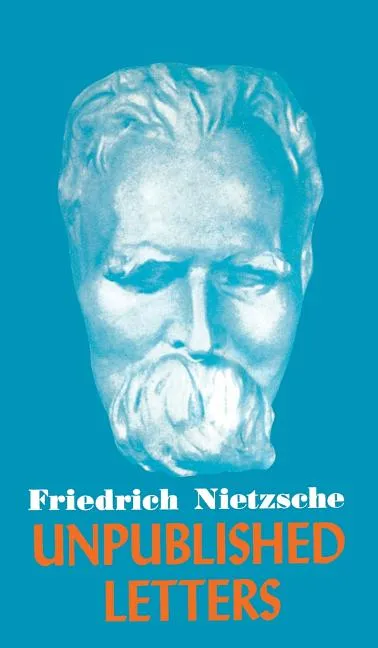
Nietzsche Unpublished Letters
Report an issue
Tell us what's wrong and we'll take a look.
Thanks – we got it. We'll review and follow up if needed.
Discover the compelling private world of the most infamous philosopher of the nineteenth century in Nietzsche's Unpublished Letters. With correspondence to Nietzsche's inner circle-including several titillating letters to his sister-Nietzsche's Unpublished Letters gives readers a never-before-seen look into the philosopher's daily life. Friedrich Nietzsche was a German philosopher and a founder of the Existentialist school of thought. He is famous for his controversial philosophies challenging Christianity, religion, and morality. Nietzsche was born in a small Prussian village in 1844 to a large Lutheran family, and his early childhood was largely marked by the deaths of his father and brother. Nietzsche attended the University of Bonn to study philology, where he discovered the philosophies of Arthur Schopenhauer and Immanuel Kant. He also formed a close friendship with Wilhelm Wagner, and with the help of Wagner, Nietzsche secured a position teaching philology at the University of Basel when he was only 24. This friendship abruptly ended in 1878 with Nietzsche's book Human, All-too-Human. Shortly after, his health began deteriorating, and he struck up a nomadic, stateless existence during which he wrote his most enduring works, including The Gay Science and Thus Spoke Zarathustra. In 1889, Nietzsche suffered a mental breakdown, and his sister Elisabeth cared for him until his death in 1900.
Friedrich Wilhelm Nietzsche
Friedrich Nietzsche was a German philosopher and author. Born into a line of Protestant churchman, Nietzsche studied Classical literature and language before becoming a professor at the University of Basel in Switzerland. He became a philosopher after reading Schopenhauer, who suggested that God does not exist, and that life is filled with pain and suffering. Nietzsche’s first work of prominence was The Birth of Tragedy in 1872, which contained new theories regarding the origins of classical Greek culture. From 1883 to 1885 Nietzsche composed his most famous work, Thus Spake Zarathustra, in which he famously proclaimed that “God is dead.” He went on to release several more notable works including Beyond Good and Evil and The Genealogy of Morals, both of which dealt with the origins of moral values. Nietzsche suffered a nervous breakdown in 1889 and passed away in 1900, but not before giving us his most famous quote, “From life's school of war: what does not kill me makes me stronger.”
More by Friedrich Wilhelm Nietzsche




Why Readwise Books?
Readwise Books is an ebook & audiobook platform that automatically logs how much you and your friends read, making it fun and easy to read more. Learn more →