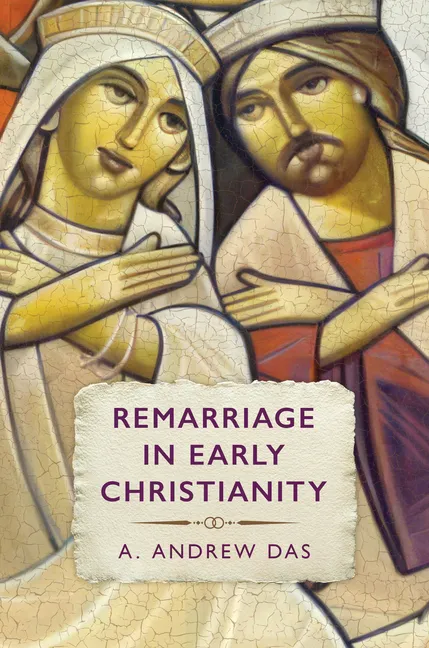
Remarriage in Early Christianity
Report an issue
Tell us what's wrong and we'll take a look.
Thanks – we got it. We'll review and follow up if needed.
The New Testament sends mixed messages about divorce. Jesus forbids it in Mark's and Luke's Gospels, but he seems to make an exception for victims of infidelity in Matthew's Gospel. Paul permits divorce in 1 Corinthians when an unbeliever initiates it. Yet other Pauline passages imply that remarriage after divorce constitutes adultery.
A. Andrew Das confronts this dissonance in Remarriage in Early Christianity. Challenging scholarly consensus, Das argues that early Christians did not approve of remarriage after divorce. His argument--covering contemporary Jewish and Greco-Roman contexts, the Gospels, Paul's letters, and ante-Nicene interpretation--reveals greater consistency in early Christianity than is often assumed. Das pays special attention to the Greek words used in contemporary bills of divorce and in the New Testament, offering much-needed clarity on hotly contested concepts like porneia.
At once sensitive and objective, Das finds an exegetically sound answer to the question of remarriage among early Christians. This bold study will challenge scholars and enlighten any Christian concerned with what Scripture has to say on this perennially relevant topic.
Choice Outstanding Academic Titles List (2024)
A Andrew Das
A. Andrew Das is Niebuhr Distinguished Chair and Professor of Religious Studies at Elmhurst University and a specialist in early Christianity and in the life and letters of Paul. His recent books include Remarriage in Early Christianity (2024), Scripture, Texts, and Tracings in Galatians and 1 Thessalonians (2023), Scriptures, Texts, and Tracings in 2 Corinthians and Philippians (2022), and Scripture, Texts, and Tracings in Romans (2021).
More by A Andrew Das


Why Readwise Books?
Readwise Books is an ebook & audiobook platform that automatically logs how much you and your friends read, making it fun and easy to read more. Learn more →