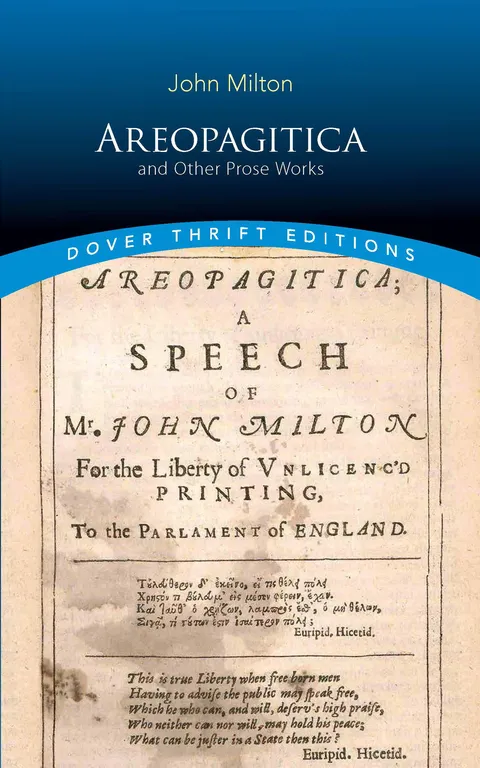
Areopagitica and Other Prose Works
Report an issue
Tell us what's wrong and we'll take a look.
Thanks – we got it. We'll review and follow up if needed.
In addition to the "Areopagitica," this collection of Milton's most significant prose works includes "Of Education," a tract on educational reform; "Meditation Upon Divine Justice and The Death of King Charles the First," a rationale for the overthrow of the monarchy; "The Doctrine and Disciple of Divorce," in which the author urges the enactment of a virtually unheard-of reform allowing divorce for incompatibility and the right of remarriage; and "Autobiographical Extracts," featuring highlights from Milton's memoirs.
John Milton
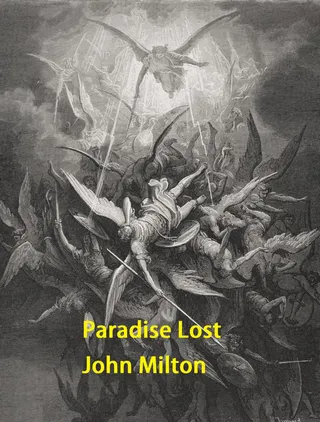
John Milton was a 17th century writer, journalist and poet born on 9 December 1608 in London, England. His parents were John Milton, Sr. and Sarah Jeffery, who lived in a affluent neighbourhood of merchants. He was educated at St. Paul's School, proceeded by the University of Cambridge. At Cambridge, Milton was affectionate with Edward King, for whom he later wrote Lycidas. He understood at least 10 languages, and was exceedingly well-read in literature, history, theology, philosophy and natural sciences. Milton became very busy in politics, and often wrote political pamphlets along with his other writings. One of his first major works, Comus, a Masque, was written in 1932. In 1942, the Civil War began and its effects impressed Milton directly. He married Mary Powell, daughter of a Royalist family from Oxford. While Milton's impression as a prose writer was great, of equal or greater importance is his poetry. He spent his life clashing with ideas of personal, political and religious freedom in the conditions of different forms of governance by the Church and state. Milton is well-known for Paradise Lost, widely regarded as the greatest epic poem in English. Milton died of kidney failure on 8 November 1674.
More by John Milton





Why Readwise Books?
Readwise Books is an ebook & audiobook platform that automatically logs how much you and your friends read, making it fun and easy to read more. Learn more →