Report an issue
Tell us what's wrong and we'll take a look.
Thanks – we got it. We'll review and follow up if needed.
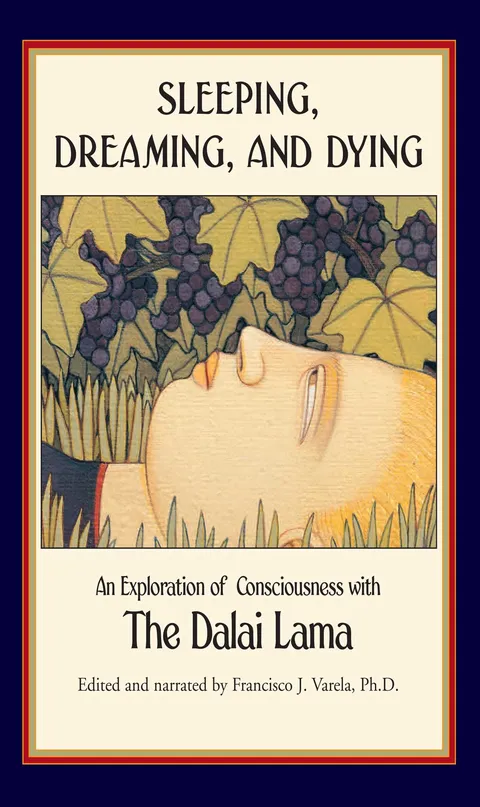
An absorbing account of a dialogue between leading Western scientists and the foremost representative of Buddhism today, the Dalai Lama of Tibet.
For modern science, the transitional states of consciousness lie at the forefront of research in many fields. For a Buddhist practitioner these same states present crucial opportunities to explore and transform consciousness itself. This book is the account of a historic dialogue between leading Western scientists and the Dalai Lama of Tibet. Revolving around three key moments of consciousness--sleep, dreams, and death--the conversations recorded here are both engrossing and highly readable. Whether the topic is lucid dreaming, near-death experiences, or the very structure of consciousness itself, the reader is continually surprised and delighted.
Narrated by Francisco Varela, an internationally recognized neuroscientist, the book begins with insightful remarks on the notion of personal identity by noted philosopher Charles Taylor, author of the acclaimed Sources of Self. This sets the stage for Dr. Jerome Engel, Dr. Joyce MacDougal, and others to engage in extraordinary exchanges with the Dalai Lama on topics ranging from the neurology of sleep to the yoga of dreams.
Remarkable convergences between the Western scientific tradition and the Buddhist contemplative sciences are revealed. Dr. Jayne Gackenbach's discussion of lucid dreaming, for example, prompts a detailed and fascinating response from the Dalai Lama on the manipulation of dreams by Buddhist meditators. The conversations also reveal provocative divergences of opinion, as when the Dalai Lama expresses skepticism about "Near-Death Experiences" as presented by Joan Halifax. The conversations are engrossing and highly readable. Any reader interested in psychology, neuroscience, Buddhism, or the alternative worlds of dreams will surely enjoy Sleeping, Dreaming, and Dying.
Dalai Lama
One of the best-known global figures, His Holiness the Dalai Lama is the spiritual leader of Tibetan Buddhism and a powerful symbol of Tibet and its unique civilization. He is an important voice for compassion, and in recognition of his advocacy for world peace and environmental concerns, he was awarded the Nobel Peace Prize in 1989. He has received numerous other international awards, including the highest civilian honor in the United States, the U.S. Congressional Gold Medal. Since being called upon to assume the leadership of Tibet, he has worked tirelessly for the freedom and dignity of his people. After fleeing into exile in 1959, the Dalai Lama has lived as a stateless Tibetan in India, a country he calls his second home.
More by Dalai Lama







Why Readwise Books?
Readwise Books is an ebook & audiobook platform that automatically logs how much you and your friends read, making it fun and easy to read more. Learn more →