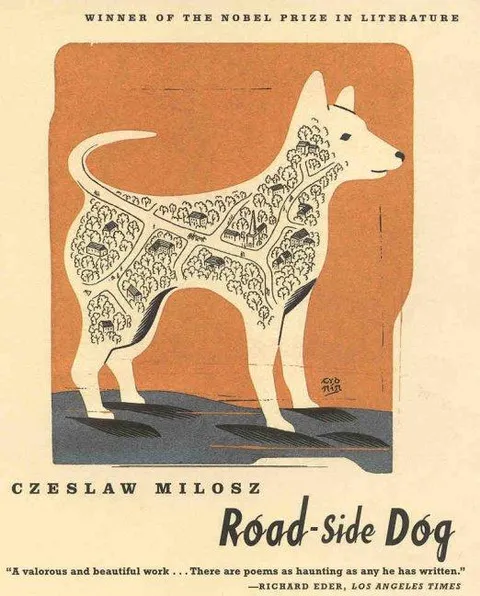
Road-Side Dog
Report an issue
Tell us what's wrong and we'll take a look.
Thanks – we got it. We'll review and follow up if needed.
"I went on a journey in order to acquaint myself with my province, in a two-horse wagon with a lot of fodder and a tin bucket rattling in the back. The bucket was required for the horses to drink from. I traveled through a country of hills and pine groves that gave way to woodlands, where swirls of smoke hovered over the roofs of houses, as if they were on fire, for they were chimneyless cabins; I crossed districts of fields and lakes. It was so interesting to be moving, to give the horses their rein, and wait until, in the next valley, a village slowly appeared, or a park with the white spot of a manor in it. And always we were barked at by a dog, assiduous in its duty. That was the beginning of the century; this is its . I have been thinking not only of the people who lived there once but also of the generations of dogs accompanying them in their everyday bustle, and one night-I don't know where it came from-in a pre-dawn sleep, that funny and tender phrase composed itself: a road-side dog." --Road-Side Dog
Czeslaw Milosz
Czeslaw Milosz was born in Szetejnie, Lithuania, in 1911. He worked with the Polish resistance movement in Warsaw during World War II and was later stationed in Paris and Washington, DC, as a Polish cultural attaché. He defected to France in 1951, and in 1960 he accepted a position at the University of California, Berkeley. He was awarded the Nobel Prize in Literature in 1980, and was a member of the American Academy and Institute of Arts and Letters. He died in 2004.
More by Czeslaw Milosz




Why Readwise Books?
Readwise Books is an ebook & audiobook platform that automatically logs how much you and your friends read, making it fun and easy to read more. Learn more →