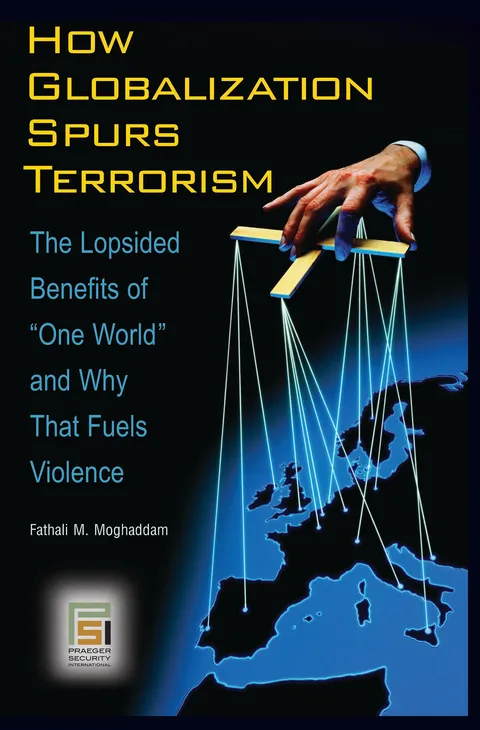
How Globalization Spurs Terrorism
The Lopsided Benefits of One World and Why That Fuels Violence
Report an issue
Tell us what's wrong and we'll take a look.
Thanks – we got it. We'll review and follow up if needed.
This book explores modern Islamic terrorism in the context of globalization and cultural evolution. 21st century terrorism is different and new, first because it relies heavily on electronic communication systems and other aspects of modern technologies, and second, because it is in large part a product of fractured globalization, with its associated threats to the collective identity of Muslims. Part one of this work contrasts globalization as an ideal with globalization as it is actually taking place, with its enormous contradictions and threats. Moghaddam, a longtime and highly respected terrorism and conflict researcher, argues that globalization is resulting in serious threats to the basic psychological needs of some, particularly in connection with collective identity. Part two explores how globalization has brought sudden contact between different groups with no previous history of large-scale contact, resulting in a rapid decline in diversity. Terrorism is one of the dysfunctional defense mechanisms of people in such conditions, facing external threats. Part three describes long-term solutions, focusing particularly on the role of women and the nature of the family in traditional Islamic societies.
Moghaddam shows us why globalization is resulting in what he calls catastrophic evolution, the rapid decline and disappearance of minority cultures and languages, and why that brings a clash of ideologies and the rise of extremism. There are also other dangerous trends, and those call for inspired solutions, springing from an understanding that traditional conflict-resolution, evolved in the shadow of the Cold War, is no longer effective and needs to change.
Fathali M. Moghaddam
Fathali Moghaddam is Professor and Director of the Interdisciplinary Program in Cognitive Science, Georgetown University, Washington, DC, and the editor of Peace and Conflict: Journal of Peace Psychology (a quarterly journal published by the American Psychological Association). Dr. Moghaddam was born in Iran, was educated from an early age in England, and worked for the United Nations and for McGill University before joining Georgetown in 1990. He returned to Iran in the "spring of revolution" in 1979 and was researching there during the hostage-taking crisis and the early years of the Iran-Iraq war. He has conducted experimental and field research in numerous cultural contexts and published extensively on radicalization, intergroup conflict, human rights and duties, the psychology of dictatorship and democracy, and causal explanations. He has received a number of prestigious academic awards, and his most recent books include The Psychology of Democracy (2016), The Psychology of Dictatorship (2013), and Questioning Causality: Scientific Explorations of Cause and Consequence Across Social Contexts (2016, with Rom Harré).
More by Fathali M. Moghaddam



Why Readwise Books?
Readwise Books is an ebook & audiobook platform that automatically logs how much you and your friends read, making it fun and easy to read more. Learn more →