Report an issue
Tell us what's wrong and we'll take a look.
Thanks – we got it. We'll review and follow up if needed.
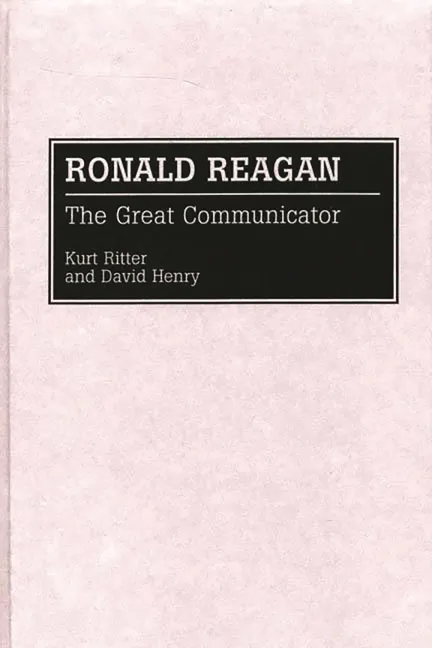
This reference combines a critical analysis of Ronald Reagan's style as a public speaker with a set of selected speeches and an extensive bibliography. Kurt Ritter and David Henry cover his oratory from his days in the motion picture industry and as a political candidate to his years as Governor of California and as President of the United States. This analysis of his use of mass media as a pulpit and his command of the TV medium is intended for students, teachers, and professionals in communications and in government.
The volume defines Ronald Reagan's role as a political pastor, his emphasis on heroes, and his appeals to values of freedom and promise. Selected speeches illustrate points made in the analysis. A chronology of his major speeches is given, along with an extensive bibliography of primary and secondary sources. A full index is also provided. This book will be of great interest to students of oratory, speech communication specialists, political scientists, and others needing an overview and texts of President Reagan's speeches.
David Thoreau Henry
Henry David Thoreau was an American author who lived from July 12, 1817, to May 6, 1862. He wrote essays, poems, and philosophical works. For his book Walden, which is about simple life in nature, and his essay "Civil Disobedience," which supports peaceful disobedience against an unfair government, he is the most famous transcendentalist. More than 20 books, articles, essays, diaries, and poems were written by Thoreau. His works on natural history and philosophy, in which he predicted the methods and results of ecology and environmental history, two sources of modern environmentalism, are some of the things that will last forever. He writes in a way that combines close observation of nature, personal experience, sharp rhetoric, symbolic meanings, and historical knowledge. It has a poetic sensibility, a philosophical austerity, and an attention to practical detail. He was also very interested in how to survive in harsh conditions, as well as in historical change and natural decay. At the same time, he pushed people to give up waste and fantasy in order to find out what life's real needs are. Thoreau fought against slavery his whole life. In his speeches, he criticized the law for fugitive slaves, praised the works of Wendell Phillips, and defended John Brown, who also worked to end slavery.


Why Readwise Books?
Readwise Books is an ebook & audiobook platform that automatically logs how much you and your friends read, making it fun and easy to read more. Learn more →