Report an issue
Tell us what's wrong and we'll take a look.
Thanks – we got it. We'll review and follow up if needed.
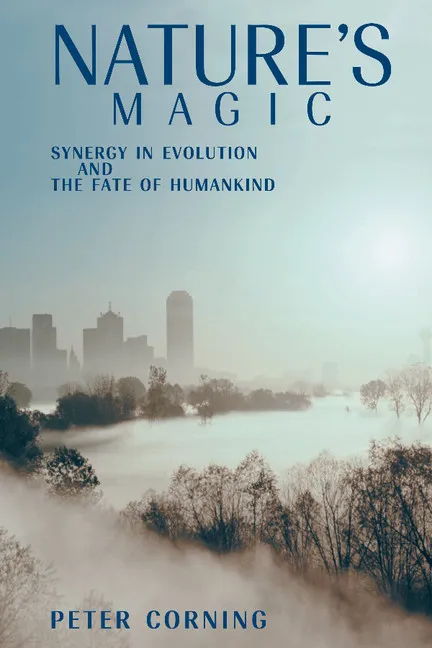
In Nature's Magic Peter Corning states that synergy--a vaguely familiar term to many of us--has been a wellspring of creativity in the natural world and has played a key role in the evolution of cooperation and complexity at all levels, from physics and chemistry to the latest human technologies. The 'Synergism Hypothesis' asserts that synergy is more than a class of interesting and ubiquitous effects. It has also been a major causal agency in evolution; it represents a unifying explanation for biological complexity and represents a different perspective on the evolutionary process. In contrast to gene-centered theories, or postulates of self-organization and emergent 'laws' of complexity, the Synergism Hypothesis represents, in essence, an 'economic' (or bio-economic) theory of complexity. Peter A. Corning, Ph.D., is the Director of the Institute for the Study of Complex Systems in Palo Alto, California. He has published numerous research papers and articles and three previous books, one of which was a theoretical monograph on the role of synergy in evolution, The Synergism Hypothesis: A Theory of Progressive Evolution (McGraw-Hill, 1983).


Why Readwise Books?
Readwise Books is an ebook & audiobook platform that automatically logs how much you and your friends read, making it fun and easy to read more. Learn more →