Report an issue
Tell us what's wrong and we'll take a look.
Thanks – we got it. We'll review and follow up if needed.
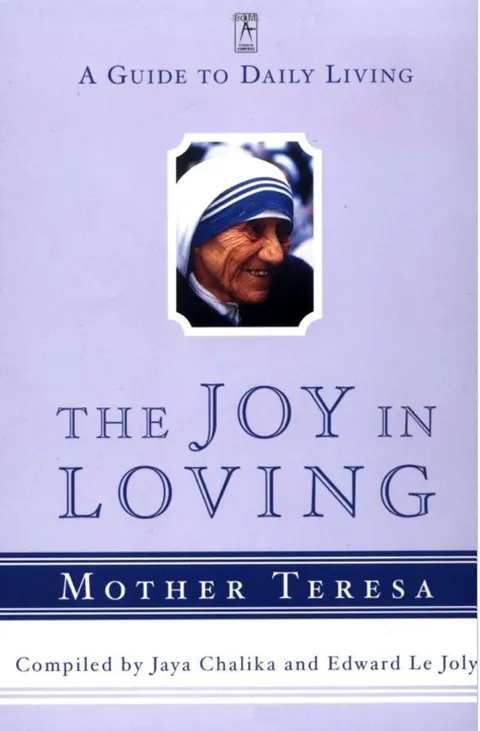
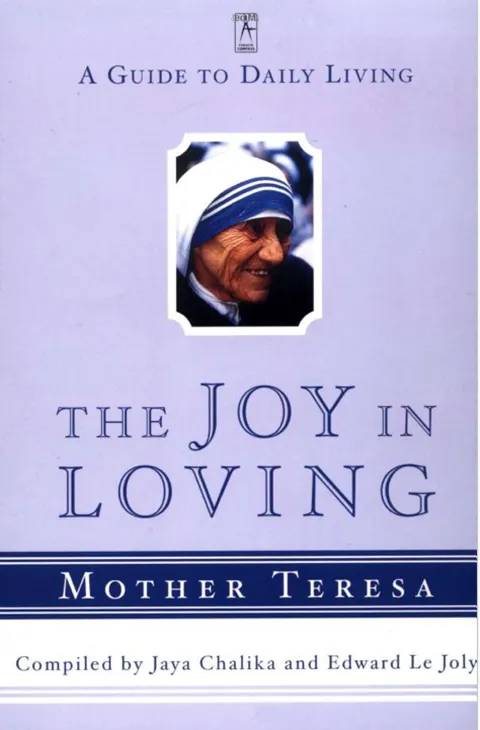
A year of daily inspiration from the renowned spiritual leader, Mother Teresa.
The provocative ideas and touching insights found in The Joy in Loving spring from incidents in Mother Teresa's own remarkable life. She speaks of men and women who have lived and died uncomplainingly, even in the midst of great poverty and deprivation; of wealthy businessmen whose indifference has been transformed into compassion and charity, and of her encounters with people and governments around the globe. Through all of this, Mother Teresa emphasizes the need for a disciplined, loving family life, for "in the home begins the disruption of the peace of the world." Drawing on more than seventy years of selfless service to the poorest of the poor, she discusses the importance of work and prayer, charity and service, the right to life and, above all, the need to love--unconditionally and absolutely.
Mother Teresa
Born in Macedonia on August 26, 1910, Mary Teresa Bojaxhiu was fascinated by the lives of missionaries from a young age. At age 18, she left home to join the Sisters of Loreto in Ireland. In 1929, she began her novitiate in Darjeeling, India. Her first religious vows took place on May 24, 1931, and she chose the name “Teresa” after St. Therese of Lisieux, who is the patron saint of missionaries. She continued to serve as a teacher with the Sisters of Loreto in Calcutta, India for almost twenty years. However, the extreme poverty that existed just outside of the convent walls continually tugged at Mother Teresa’s heart, inviting her to a life of radical compassion. In 1948, she asked (and was granted) permission to begin working with the poorest of the poor in the Calcutta slums.
Mother Teresa received basic medical training to provide care for those who lived in the slums. She founded a school and shortly after, in 1950, founded the Missionaries of Charity, a new religious community seeking to love and care for “the poorest of the poor” and those whom no one was willing to care for. In 1952 she opened her first hospice to help people die with dignity. In a country with multiple religious identities—primarily Hindu, Muslim, and Catholic—she worked to ensure each person died with dignity according to his or her own faith. She also opened a hospice for those suffering from leprosy and in 1955 opened a home for orphans and homeless children. By the 1960s, word of Mother Teresa’s work had spread, inspiring an increase in volunteers, religious sisters, and donations that allowed this great mission to expand across India. Her message—to radically love and serve all people—was welcomed and spread around the world.
In 1979 Mother Teresa received the Nobel Peace Prize for her work. She refused the ceremonial banquet and instead asked that the $192,000 cost be given to the poor in India. Despite her personal humility she attracted international attention and praise for her work. After experiencing a heart attack in 1983, Mother Teresa continued to face various medical complications. She resigned as the head of the Missionaries of Charity on March 13, 1997, and died on September 5 of that year. She was mourned by both religious and non-religious communities alike. She was canonized by the Catholic Church on September 4, 2016.
More by Mother Teresa














Why Readwise Books?
Readwise Books is an ebook & audiobook platform that automatically logs how much you and your friends read, making it fun and easy to read more. Learn more →