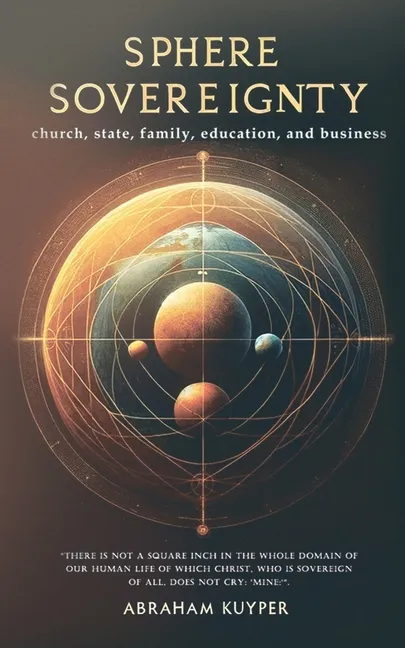
Sphere Sovereignty
Report an issue
Tell us what's wrong and we'll take a look.
Thanks – we got it. We'll review and follow up if needed.
"Sphere Sovereignty" by Abraham Kuyper offers a theological and philosophical framework, emphasizing the distinct, God-ordained authorities within various spheres of life-such as the church, state, family, and education. Kuyper argues that each sphere has its own autonomy, directly under God, without interference from the others, particularly the state. This work not only navigates the balance between these spheres but also critiques the overreach of state power into areas like the church and education. Kuyper's insights advocate for a society where diverse domains operate freely within their God-given jurisdictions, championing the principle that Christ claims sovereignty over "every square inch" of life. His vision remains influential in discussions on faith, politics, and society, offering a blueprint for Christian engagement in the public square while respecting the distinct roles and responsibilities divinely appointed to each sphere of life.
In his lecture, Abraham Kuyper contrasted sphere sovereignty with state sovereignty, criticizing the latter for leading to a deification of the state and suppression of other life spheres, including academia. He also addressed "popular sovereignty," stemming from the French Revolution, as promoting an idolatry of individual rights. Advocating for sphere sovereignty, Kuyper envisioned the Free University to operate under divine authority, free from external institutional pressures, aiming for God's glory rather than that of the state or individual. This vision of pluralistic social theory, emphasizing unique, God-ordained spheres, remains influential in Reformed Christian circles.
Abraham Kuyper delivered the lectures on Sphere Sovereignty in 1880. These lectures were part of a series he gave at the Free University in Amsterdam, which he helped to found.
Abraham Kuyper
Abraham Kuyper (1837-1920) was one of the most extraordinary individuals of his time. A prolific intellectual and theologian, he founded the Free University in Amsterdam and was instrumental in the development of Neo-Calvinism. He was also an active politician, serving as a member of Parliament in the Netherlands beginning in 1874 and serving as Prime Minister from 1901 to 1905. At this intersection of church and state, he devoted much of his writing toward developing a public theology. His passion was to faithfully understand and engage culture through a Christian worldview. The most famous example is his articulation of the doctrine of common grace. His work has influenced countless others, including Francis Schaeffer, Cornelius Van Til, and Alvin Plantinga.
More by Abraham Kuyper


Why Readwise Books?
Readwise Books is an ebook & audiobook platform that automatically logs how much you and your friends read, making it fun and easy to read more. Learn more →